

It’s official: the Australian Crocs are back, and the future is brighter than ever.
The feeling was very different this time two years ago, when the Crocs slumped to a 15th-place finish at the 2024 FIBA Under-17 Men’s World Cup. That marked Australia’s worst-ever result at the event, and made it four straight tournaments finishing outside of the top five. There were some promising signs, but for a country with ever-growing hopes and expectations on the court, it was a disappointing step back.
Last month’s World Cup in Türkiye was a chance to bounce back, and the Crocs did exactly that. With a new-look coaching staff and an uber-talented squad, they stormed through the early stages of the tournament and ultimately walked away with a bronze medal.
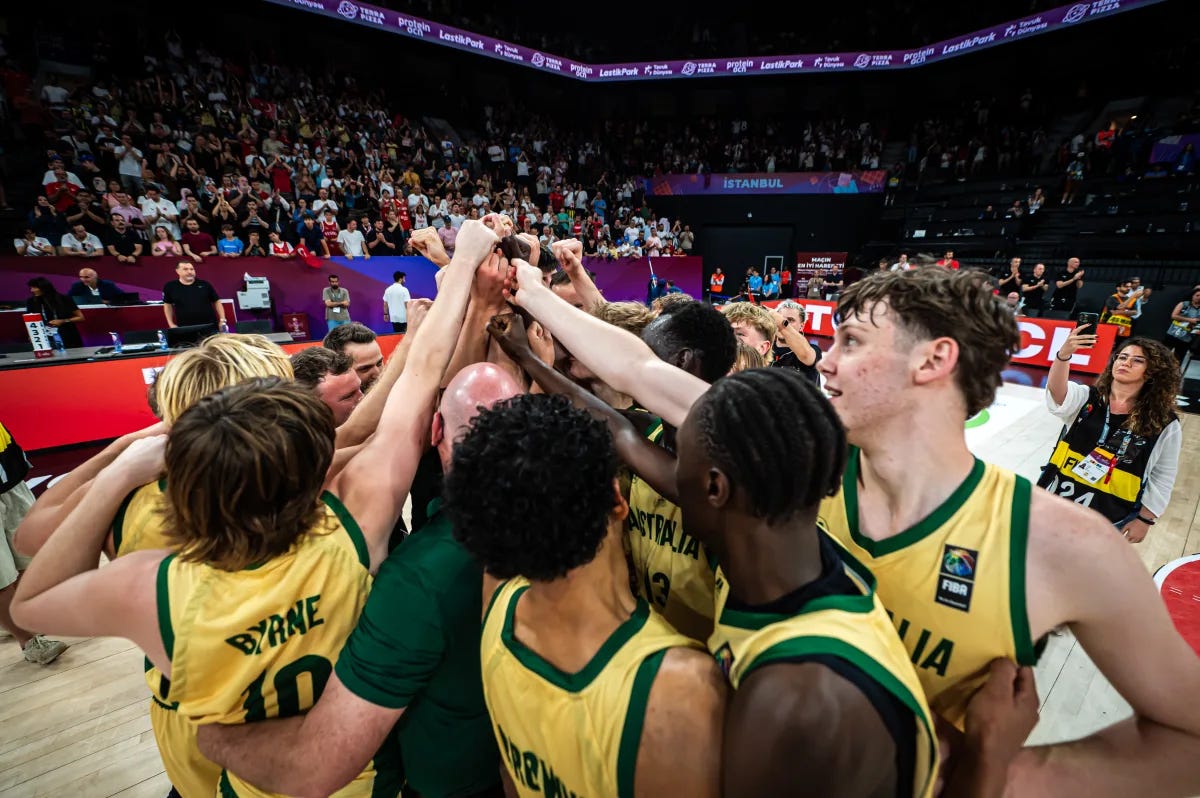
Credit: FIBA
That result was a huge tick for not just the program, but for so many of the players who were able to impress on the world stage.
Aussie depth steps up to break medal drought
It was a welcome return to the podium for the Crocs, who won back-to-back silver medals in 2012 and 2014 but had failed to reach the semi-finals in the four tournaments since. While they finished one step lower this time around, their 6-1 win-loss record was actually Australia’s best ever at the event – they were beaten by the United States twice in 2012, and in 2014, they fell to Canada in the group stage before again coming up short against the Americans in the final.
This year, they were untouchable up until the semi-finals, where they again ran into the American buzzsaw. Prior to that, the wins were impressive, including a 22-point blowout of eventual silver medallists Serbia, another double-digit win over a talented Canadian squad, and a composed bounceback effort to take down the hosts Türkiye in the bronze medal game.
There were stars that led the way – more on them later – but it was a top-down effort from the entire Crocs squad. Of their 12 players, 10 averaged double-digit minutes across the tournament, and all made plays when their number was called. “What impressed me most wasn’t necessarily the points scored or the highlights, it was the willingness to sacrifice for the team,” head coach Greg Vanderjagt told Basketball.com.au after the tournament. “Different players carried us on different nights, and nobody cared who got the credit as long as the group found success.”
Point to any player across the depth chart, and you’ll find a key contributor to one or more of Australia’s wins. Andrew Watene was a backup to the team’s lead guards, but he starred against Serbia and stayed ready for his spot minutes throughout. Alex Mabbott played a similar role at centre and brought a rugged edge with his rebounding and shot-blocking. Riak Akhuar was the ultimate defensive Swiss army knife, guarding multiple positions at a high level and finishing fourth in the tournament in blocks. John Aryang started but played a supporting role, and he produced countless highlights and just as many key plays.
Maybe most impressive of all was how Vanderjagt and his staff used that depth, and their ability to bring out the best of every single player. It’s been a turbulent last few years for the head coach with the Brisbane Bullets and their coaching carousel, but an escape from the pro ranks might have been the perfect remedy. The Crocs were a well-oiled machine throughout, blending the trademark Aussie grit and intensity with a level of execution and organisation that can be rare in junior teams.
“We never spoke about outcomes during this journey with this group of athletes, we focused on our process of getting better every day and ensuring that would drive our outcomes more than anything,” he told Basketball.com.au.
Luke Paul is the real deal
Very few players came into the World Cup with more hype than Luke Paul. The youngest player to ever sign a contract with the NBL’s Next Stars program, he claimed MVP honours at last year’s Under-16 Asia Cup, was named to the All-Star Five at the Under-17 Oceania Cup, and starred for WA Metro at June’s national championships. It’s easy to see why FIBA ranked him as the eighth-best prospect ahead of the tournament, and why plenty rated him even more highly.
Safe to say, the 17-year-old more than lived up to the hype. He was the engine of Australia’s offence, finishing third among all players in assists while also being a top-15 scorer; he stuffed the stat sheet, averaging 15.3 points, 6.4 rebounds, 7.1 assists, 1.4 steals and 1.3 blocks, and finishing as the only player to average more than 10-5-5-1-1; and he earned selection in the tournament’s All Star Five, joining Dejan Vasiljevic and Dante Exum as the only Australians ever to do so. Most importantly, he led from the front as the Crocs climbed onto the podium, culminating in a 19-point, 10-rebound and seven-assist masterclass in the bronze medal game.
Already regarded as one of the best playmakers in the world for his age, Paul’s offensive skillset was on full display. Australia finished third in the tournament in assists despite generally playing at a slower pace, and that started with their point guard, who was unselfish to a fault at times and always looking to get his teammates involved. He processes the game so much faster than most in his age group, able to see the play unfolding and wait for an opening to exploit as it does.
Always a streaky shooter, he showed some promising signs of development in Türkiye, shooting 55.6% from three with a tidy and smooth form. As the Crocs ran him through a heavy dose of screens, that forced defences to make tough decisions – go over the top and let him get into the paint and create, or go under and give him the open three. Most teams did the former, and he showed great patience in navigating the heart of the defence and making plays; when Slovenia tried the latter, he torched them for 20 points and five made triples.
It wasn’t all roses, and Paul struggled with turnovers throughout, posting four or more in five of Australia’s seven games. That was most glaring in the semi-final, where the length and athleticism of the United States brought him undone. The Crocs struggled to break the Americans down, scoring just 65 points in a blowout loss, and Paul finished with six turnovers and three assists. That could be cause for concern as he prepares for the grown men of the NBL, and later the elite athletes in the NBA; he’ll never play with the same sort of talent deficit that the Crocs faced, though, up against a team with an average winning margin of more than 50 points and elite NBA prospects at every spot.
Even with one down game, the good far outweighed the bad for Australia’s brightest young star. It made his bounceback effort against Türkiye all the more impressive, and his performance on the whole should have Cairns Taipans fans excited for their next two seasons together. He’ll surely still be eased into the action in NBL26, but with the Taipans building a strong group of veterans, coach Adam Forde might be willing to throw him into the fire sooner rather than later.
Yahya Basaran: Australia’s next great big man?
Ahead of the World Cup, The Pick and Roll’s Ayush Gautam took a deep dive into Australia’s best young big men. Not since Andrew Bogut have the Boomers had a dominant paint presence at their disposal, with stretch bigs and small ball fives manning the middle in recent years. One player he flagged was Yahya Basaran, with the 17-year-old seven-footer coming off a dominant Under-18 National Championships campaign and his first few months with the Basketball Centre of Excellence.
Still relatively untested at the international level coming into the World Cup, Basaran played just two games at last year’s Under-17 Oceania Cup but did plenty to impress. That had him flagged in Australia as a player to watch, but in Türkiye, he announced himself on the world stage. He finished the tournament second among all players in blocked shots, averaging 9.6 points, 7.9 rebounds and 2.3 blocks in just 20 minutes per game, and proving to be a legitimate two-way force around the basket.
His size alone was a huge point of difference – listed at seven feet on the dot, he was one of just five seven-footers at the tournament, and the only one playing for a top-four side. Maybe he’s had a growth spurt since his last measurements, but he looks even bigger than that on the court, and with long arms to match, he eats up a huge amount of space in the paint. That showed up most on the defensive end, where he was able to block shots and vacuum up rebounds even when caught a little out of position.
It would be easy for a player at his size to fall into the trap and try to bulldoze the opposition offensively, particularly against smaller juniors, but Basaran is already a more polished player than that. While his scoring numbers don’t jump off the page, they did place him in the top ten for centres, and it’s the way that he got those points that was most impressive. He showed a level of patience in the post that belied his years, making subtle moves and waiting for his defender to bite before rising up or stepping through to shoot.
Seeing that, it should be no surprise to learn which NBA player he takes inspiration from. “I study Nikola Jokić’s footwork and try to learn from it,” he told Anadolu Agency during the tournament.
He attributes his recent rapid development to his short time so far at the Centre of Excellence, which bodes even better for his future as he continues to put in work there. “Every day I’m improving there, and that’s showing in my performances… it brings together the best 12 players in the country on one team, and that has helped me improve tremendously. I feel like I’m getting better every day,” he told Anadolu Agency.
State team stars to elite role players
In any national team – any country, any sport, any age group – players will need to take on new roles. Just about every player to ever represent their country is a star at the lower levels, but not all can be the star as they keep stepping up. Most will need to take a step back and join the supporting cast; some can’t make that work, but some can do so and thrive.
Every player on the Crocs roster seemed to truly embrace their role, but two players embodied that balance more than anyone. For years now, Antonio Browne and Will Hamilton have starred at the national championships as the leaders and focal points for their respective states. By now, both are also veterans in the national team program – the World Cup was Hamilton’s fourth tournament representing his country, while it was the third for Browne – but both were more impressive than ever in Türkiye.
Browne has long been a highlight machine for New South Wales Metro, playing as the lead guard for a team that consistently competes for national titles. At the World Cup, though, he proved to be the perfect foil for Luke Paul, providing secondary playmaking and a pressure release when defences keyed in on the point guard, and then running the second unit with aplomb when he went to the bench. By tournament’s end he’d done a little of everything as needed, averaging 9.7 points, 3.7 rebounds, 4.6 assists and 1.4 steals per game.
He did all of that even as he struggled to find his shot, making just 23.5% of his threes and failing to make a shot from deep in five of Australia’s seven games. In the end, that didn’t even matter – he was able to get downhill easily and often, either by breaking down his man off the dribble or attacking a shifting defence off the catch. Just as he helped Paul, Paul was able to draw attention and set the table for his running mate; hopefully, this was just one of many tournaments that the two will play together.

 Tiktok failed to load.
Enable 3rd party cookies or use another browser
At state level, Hamilton has always been able to lean on his physicality. Standing at six-foot-five, with the burst of a guard but the strength and power to match any big man, he’s long been able to overpower just about any matchup thrown at him in Australia. Even at the World Cup, he was able to show off those physical traits, but they alone wouldn’t have been enough to make him effective.
Instead, he showed incredible growth in what has always been viewed as his biggest swing skill. Never a consistent shooter, he was lights out in Türkiye, shooting 42.9% on four three point attempts per game and becoming the perfect floor-spacer alongside Australia’s dynamic guard rotation. It was a remarkable step forward for the Victoria Country star, and even more impressive that he did it after going 0-6 from the field in the opening game of the tournament. Sometimes viewed as a ‘tweener’ and without a clear role projection as a future pro, Hamilton’s tournament was a great first step towards changing those perceptions, and a testament to his work rate and development.