
Why so many top flight Opals move to Europe
Steph Reid: "I know this career could be cut short at any moment and you’ve got to make the most of it while you have it."

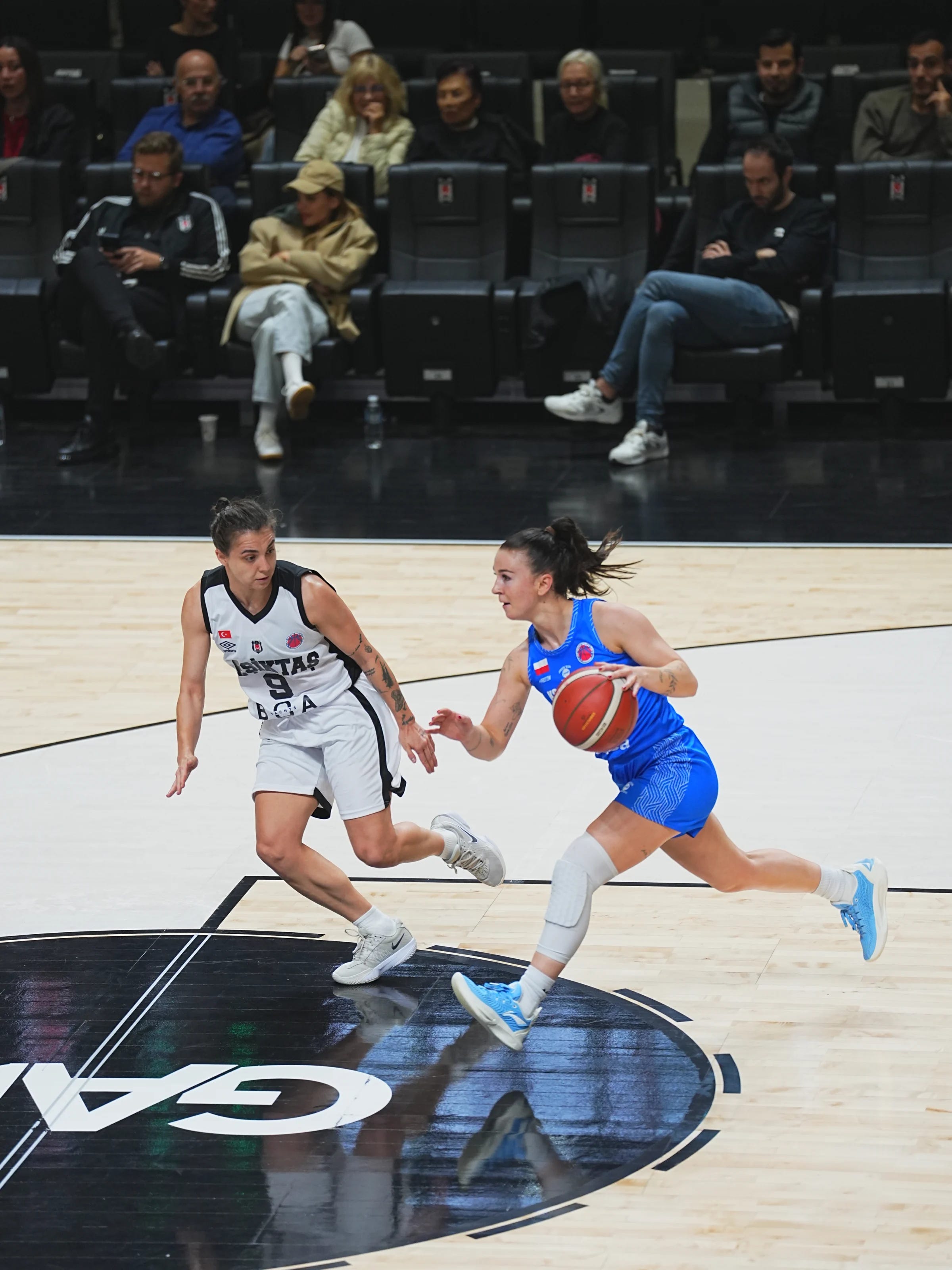
Photo credit: FIBA EuroCup Women
A new era in the WNBL is underway, with a collective bargaining agreement (CBA) that’s more closely aligned to the quality of its players. At the 2025 WNBL awards night, incoming owner Robyn Denholm took to the stage, announcing that one of her main goals was for “every Australian Opal to play in the WNBL.”
Fast forward to the next season and there had been some movement in the right direction with Zitina Aokuso and Shyla Heal returning to home soil. Sara Blicavs and Lauren Nicholson chose for their return to be in the WNBL, although they had spent WNBL25 sidelined rather than overseas. Even still, this collection of four incoming Opals outsize the three outgoing in Lauren Mansfield, Sami Whitcomb and Alice Kunek. Although imports are, in fact, not Opals, the class for WNBL26 is one of the best the league has ever seen, so the investment in the league is definitely attracting top level talent.
As for our exiting Opals, Mansfield made the move to New Zealand where the season ends roughly three months before the WNBL, so that could be an interesting one to keep tabs on. Turkey was calling for both Whitcomb and Kunek as they found their way to Besiktas and Kayseri, respectively. The two addressed their motives for the want to play in Europe, with Whitcomb telling The Pick and Roll:
“Europe, for me, is about the entire experience and lifestyle. I love experiencing the different cultures and seeing new places, while also competing in incredibly tough leagues.”
Kunek shared similar reasons with The Pick and Roll. “The competition’s great. You get to see a different part of the world. You get to learn a new culture. It’s really,” she paused, “I wouldn’t say the word is humility, but there is a little bit of humility. You realise that we just don’t need that much to live. It really simplifies life for you and I really like that aspect.”
There’s an immediate intrigue into customs that would be foreign to most Australians, as well as life experiences that cannot be replicated at home. It helps that the quality of the Turkish league is top class, as Kunek stated. “I think Turkey’s the best league in the world outside the WNBA at the moment. Now there’s no Russia, everyone’s playing in Turkey, so it’s the best place to play right now, I think.”
Beyond this, there’s the opportunity of playing in the EuroLeague or EuroCup, yet Kunek is on the contrary for this European foire. “I’ve played five or six years in Europe. Honestly, I’ve just loved my time here in Europe. It’s probably where I’ve seen the most growth in myself and probably the most growth in my basketball.
“I just wanted to come back to Europe. I’ve always loved it over here. I can’t lie, the money’s pretty good over here. I’ve come to a team where it’s only one game a week. I only wanted one game a week. I didn’t want to play EuroLeague or EuroCup this time, just because I’m a bit older.”
Whitcomb has always been on the opposite side of the coin. “It was always a goal of mine to play EuroLeague so that was also a draw.” Although she isn’t in the EuroLeague this season, she is in the EuroCup. Her debut for Besiktas this season was in a EuroCup game against Steph Reid and Gorzow. This was the second and final leg of the two teams fixture as Besiktas won 100-70.
The motivation for Reid’s migration blended elements from both Whitcomb and Kunek, as she told The Pick and Roll.
“So like, firstly, obviously financially. I’m making three times more in Europe than my best offer when I left [Australia]. So like, it’s really hard to justify coming home. Also we don’t pay taxes and we get paid in USD. At the end of the season they give us a tax certificate and that’s it.
“We might need to pay a little bit but at home, if I was to get paid the amount of money I get here, I would lose a massive percentage of that to tax as well. Financially, it’s a humongous difference, that’s a big reason.”
She then spoke on the growth opportunities within intra-Europe competitions. “Also just being able to play in EuroCup or EuroLeague. You’re playing against different styles. This week I was in France, which is a very strong, athletic, physical, fast brand of basketball. Whereas next week I’m going to go to Athens and it’s going to be a completely different style. Then the week after, it’s in Turkey and it’s completely different.
“It’s just so challenging and stimulating. As a basketball player you want to grow, you want to be exposed to the best players that you can in the best styles. And for me, I just feel like that has really challenged my growth, and ability to adapt, so that’s why I like Europe.” Reid is also on a path that has been realised by Whitcomb over the past few years.
As Whitcomb would analyse: “I think playing all over the world the last 3 years leading up to Paris prepared my phenomenally for that stage. I got to play a variety of styles, against the best players in the world, and I think playing both in Europe and the WNBA, paired with WNBL the last 2 seasons prior to the Olympics, was the perfect blend of FIBA international exposure and prep and then working on my game a little more intentionally back in Australia and playing that style. I couldn’t have asked for better prep.”
Reid mirrors that with precise introspection. “It’s been really difficult to adjust, but it’s very rewarding as well. I want to make the World Cup next year and so what do I need to be playing like by then? And how does this opportunity present itself? If I was selected for that team there’s six different styles of basketball that you’re going to match against. So knowing I’m here, it’s like, oh, okay, all of these different teams present opportunities for me to prepare myself and prove that I belong on that stage and hopefully get selected.”
That exposure to different styles may not be obvious to the untrained eye, but to Australians who have led the Opals to the podium as playmakers, it’s imperative. It’s also interesting to see how each elite guard sees the value in diversifying their portfolio, whether selection is on the horizon or in the rear view.
In saying this, Reid was honest about how much of her decision was based on life and how much was based on basketball.
“Like 99.9% of it. I’m pretty realistic with my career and I know afterwards I want to coach and I have a pathway that I want to follow after [playing] basketball. My career ending isn’t something that I fear. It’s something that I also am looking forward to at the same time. I know this career could be cut short at any moment and you’ve got to make the most of it while you have it.
“And like, yeah, I don’t know many people that would turn down the money that we make over here. Knowing that I can go back still for five months a year and be involved with the Opals during the European offseason and still play at the highest level. Financially it’s important for me, especially as a female athlete, to be able to make the money that I’m making and set myself up just knowing that you don’t know what’s going to come next. These opportunities don’t always present themselves, so I’ve got to take them while I have them.”
Reid’s reflective practice is equal parts palpable and ubiquitous, and she spoke about how this has developed over time. “I feel like I’ve become really reflective while in amongst the process of my career, which has been something that in the last 12 months I’ve tried to do a bit more. It’s taking a lot more lessons and being a lot more grateful.
“Because it’s really hard. Like, it’s not easy, this life is really difficult. You’re training constantly, you’re managing injuries, you’re being away from your support network. It’s not easy at all. And so a part of learning how to grow was accepting that what I do is really cool and having to be a bit more grateful for it.”
Striking the balance between appreciating opportunities and managing challenges seems to be an exceedingly difficult task, especially when both are born from presence. There’s good and bad that comes with that presence and the fact that it’s ground in reality has assisted Reid’s growth, both on and off court.
Another such challenge is the language barrier. “[In Gorzów] there’s only the three foreigners and everyone else speaks Polish, so it can be a little bit difficult. You’re in the locker room and everyone’s just having conversations and you’ve got no idea what’s going on.
“Then at dinners, everyone just speaks in Polish. You’ll just find yourself with the foreigners hanging down one end of the table. You’re like, oh, now we’re isolating ourselves because you want to be involved. But that’s just how it is. And you learn quickly that it’s not necessarily something to take personally.”
Kunek echoes the pursuit of common ground in this sentiment. “Sometimes the language barrier makes things just take that little bit longer, but you always get there in the end. Everyone does their best to help you and to make it a great experience for you. I feel like in this club, I’ve been really lucky in an unfortunate situation, they’ve really done their best to help me.”
Her unfortunate situation is a broken finger that she sustained in Kayseri’s first practice match. It’s news she has kept close to herself as she works through it and is grateful for the resources at her disposal.
“We’ve got really good doctors and physios. I unfortunately had to use the Turkish hospital system due to my finger and now doing hand therapy. I’ve been really well looked after and had really good resources to get back on court.”
On the broader resources available: “Yeah, it’s really good. We have a really big gym in my club. We’ve got great strength training, multiple gyms, our coaches are great. Our coach speaks English, but it’s not incredible, but he speaks good English and we also have our assistant, who translates.”
The resources at European clubs can differ greatly between two teams in the same country, as Whitcomb said. “Resourcing certainly varies league to league and country to country, even team to team within a country. Some are top notch though probably not comparable to the WNBA teams that have new facilities now. The WNBA charters now and that’s incredibly rare in Europe. It can be hit or miss.”
Reid lended insight into the resources at Sopron in Hungary, where she spent the 2024-25 season. “Last year at Sopron we had unbelievable facilities. They’re a historically successful team with a lot of financial backing. So they had cryo, saunas, hot and cold tubs, the weight room, all in one building. That was unbelievable, something I had never been exposed to.”
There’s so much variance between what different teams offer. With competitions like the EuroLeague and EuroCup, the context for expectations are near impossible to standardise. That goes beyond basketball, that’s a function of how connected countries are in Europe. “I’ve got a mate who went on a trip to visit his family back in Europe and his aunty actually drives over the border to get petrol from another country because they don’t have a tax on their fuel.” I’m sure we all have someone we can attribute that quote to.
Australia doesn’t share a border with any country, and the WNBL is one league with eight teams. It’s in stark contrast to Europe, where Spain shares a border with France which in turn shares a border with Italy. Those three countries combined are comparable in land size with the Northern Territory, Australia’s third biggest state or territory. Moreover, those three European countries have multiple professional basketball leagues within them. which are bound by relegation and promotion systems and with each league containing more teams than the WNBL. There’s a lot going on.
It’s a major attribute for the WNBL to have all eight teams under one brand for decision making and problem solving. As Reid shared: “the WNBL have done a lot of work with the CBA and having certain expectations of clubs, like having physios at every training. I think the WNBL is extremely professional and it depends in Europe where you end up as to what resources you have. It can differ immensely. You know, you can increase your salary and go to a club with more money, but they might have less resources than where you were prior. So it just really depends.
“I think the WNBL is taking a lot of steps in the right direction and the way that they look after their players in terms of management and forced off days and things like that is ahead. In Europe, you’re training twice a day regardless. And like, God forbid you have an off day, like, it’s just not happening here.”
Kunek touched on a key difference for the WNBL. “I would say [Turkey] is not flashy like the WNBA or the WNBL, and we don’t have huge TV deals and all those types of things.” She would add, “but it’s a really reputable league. We have games on TV. The Turkish Federation does their best to do stuff on social media. A lot of that is club-based though, compared to the league as a whole.”
As hard as it might be set expectations in European leagues, it’s always attracts some of the WNBA’s biggest stars. In Kunek’s words: “You’ve got so many different international players coming to play here. Really good American imports. You’ve got players like Gabby Williams, Kayla McBride, Iliana Rupert, Megan Gustafson, who just won a WNBA championship. You’ve got all these really amazing players now coming to Turkey to play, and it just makes the strength of the league even better.”
There’s more of a free market approach in Europe, with salaries that allow the cards to be dealt with significantly more incentive than other geographies. Diana Taurasi, many people’s GOAT, infamously sat out the entire 2015 WNBA season because her Russian team paid her the max WNBA contract not to return to the States, on top of a cool US$1 million contract to play in Russia.
Having said that, there are substantial reasons why Australian Opals continue to ply their trade in Europe, and it’s probable that this will remain the case for some time still. The European landscape did not happen overnight - resources, salaries and investment took decades to build and grow.
The WNBL is taking the right strides, and early returns on the league’s CBA are a deep green. So long as this trend line stays in the right direction, the league should celebrate it as a positive investment.