
Which emerging Opals could be in line for a call-up to the 2026 World Cup?
The winds of change are blowing, and there are spots for the taking ahead of the next World Cup. Here's who is in the mix.

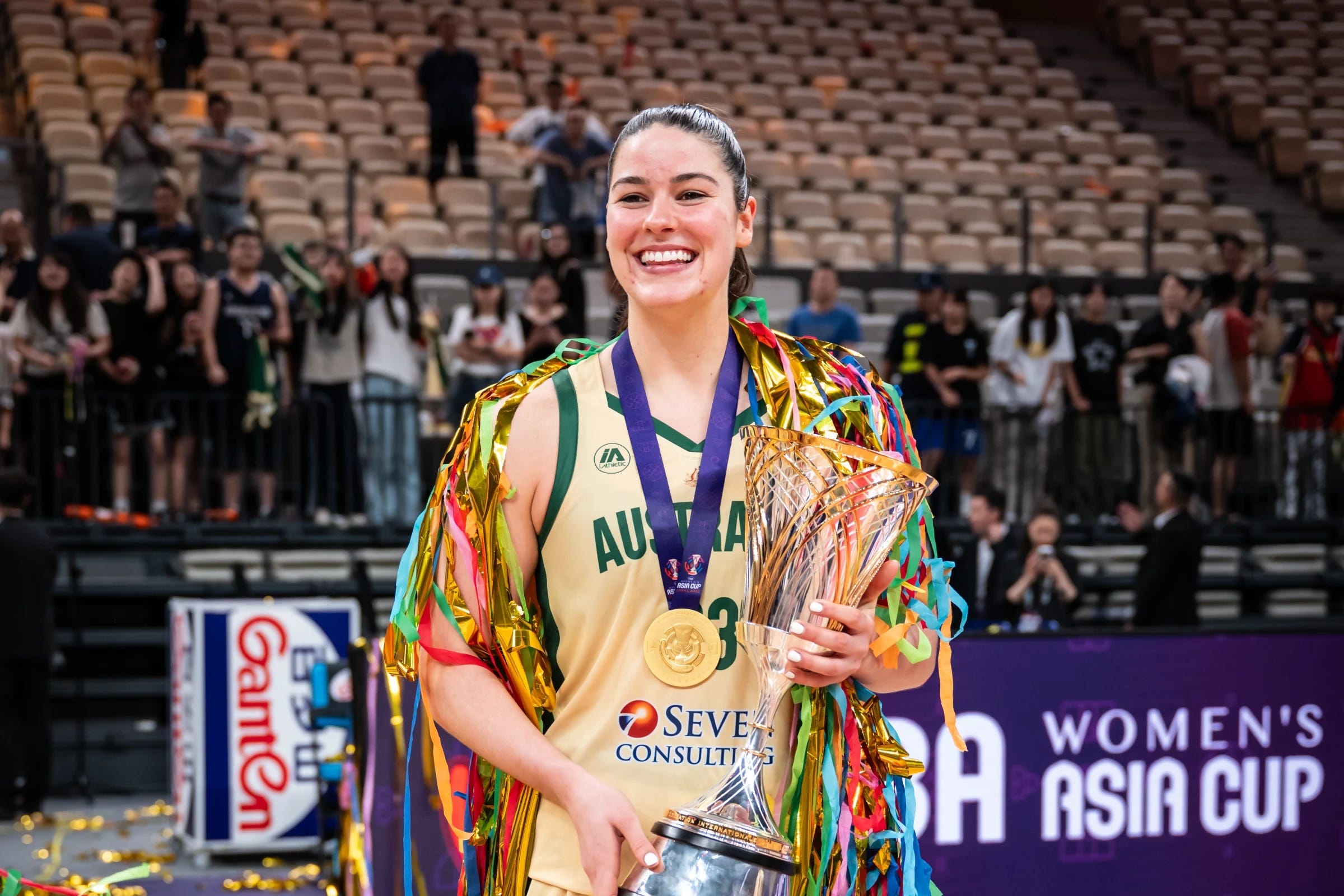
Photo credit: FIBA
Let’s take a trip down memory lane, back to the Opals’ last two major international tournaments. In 2022, they bounced back from a heartbreaking quarter-final loss to defeat Canada in the bronze medal game. In 2024, they bounced back from a heartbreaking quarter-final loss to defeat Belgium in the bronze medal game. Both euphoric highs, both remarkable triumphs, and both featuring an almost identical core group of players.
While much of that core is still very much intact, the upcoming 2026 World Cup, and subsequent 2028 Olympics, will bring about some seismic change. While some of the stalwarts from that famous win over Belgium (namely: Steph Talbot) will still be leading the charge in Germany, a number of key figures have already moved on. Captain Tess Madgen and undisputed GOAT Lauren Jackson have both since retired. Sami Whitcomb is 37, and both Cayla George and Mariana Tolo are 36. And while they’re all still thriving - beep your own horn, Cayla! - even Jackson proved Father Time is still undefeated.
On paper, we know with relative certainty the upcoming cycle of tournaments will almost certainly feature a core comprised of WNBA headliners Alanna Smith and Ezi Magbegor, the world-beating Talbot, rising stars Jade Melbourne and Izzy Borlase, as well as veterans Whitcomb, George, and Tolo.
Outside of that though? There’s a host of open spots that will be fiercely contested by a group of emerging stars who are already pressing their claims for promotion. A number of elite players - Rocci, Nicholson, Atwell and Maley - have been around the mark for multiple seasons now, but who else is in the mix to usher in the next generation of success? Let’s have a look at the strongest contenders.
Alex Fowler
Is there a more unassuming superstar? Seriously, is there? Many wouldn’t put Fowler in the superstar bracket - especially as she plays in a stacked Fire frontcourt - but her resume speaks for itself. Fowler chalked up one of the most decorated collegiate careers by an Aussie ever, was named MVP of an historic Asia Cup win, and is now arguably the most irreplaceable piece of the WNBL’s best team. Everywhere she goes, Fowler finds ways to produce. The Jack-Of-All-Trades label actually undersells Fowler, given her ability (and willingness) to get the grunt work done defensively, relentlessly crash the glass, and score at a ridiculously efficient clip (68% this season) should put her in the game’s elite category. She’ll need to win her spot in a very deep, very diverse, and very talented group of forwards, but her body of work is becoming increasingly difficult to overlook.
Ally Wilson
What an incredible story. Wilson was just about out of the WNBL post-COVID, only joining Bendigo as a late replacement for Leilani Mitchell. She quickly quashed any suggestion she didn’t belong at the highest level, and hasn’t looked back. Since joining Perth, she’s thrived in Ryan Petrik’s high octane system, which plays to her greatest strengths as a lightning quick, supersized guard not afraid to let it fly from deep. A knee injury delayed her start to the season, but she’s quickly making up for lost time. And while she’s had limited exposure to the Opals framework, she has plenty of international experience in the 3X3 arena. Her ability to create her own shot is a huge bonus, but the real difference? There are only so many players who can compete with the world’s bigger, stronger guards at both ends of the floor.
Georgia Amoore
While there’s been so much to celebrate for Australians in the WNBA this past year, Amoore’s lost season was a brutal blow. No Australian has had a bigger impact on the collegiate game in recent years, and the flamethrowing guard was widely anticipated to make a major impact in Washington. While a torn ACL has delayed her WNBA debut has been delayed until next year, it’ll be worth the wait. Amoore possesses a rare swagger, and is both a fearless shooter and competitor with a deep, deep bag. One of a handful of players to be invited to privately work out with Kelsey Plum, she’s made no secret of her love for getting in the lab and refining her craft. Should she return at full strength, her rare blend of elite shooting and passing wizardry will be hard to overlook.
Sara Blicavs
Blicavs remarkable comeback from spinal fusion surgery has easily been the feel-good story of Australian basketball. While she’s far from a new face, having played in the Opals’ failed 2018 World Cup campaign, she’s again looming as a key piece in Australia’s squad. She’s hit the ground running in Canberra, showing no sluggishness from her spinal surgery. If anything, she arguably looks more mobile than ever. Her blend of experience, athleticism, and polish is rare, especially for someone her size. Should her body hold up, she’ll be hard to keep out of the team heading to Turkey. Blicavs told me she has an eye on the 2028 Olympics, and is intent on again wearing the green and gold. The World Cup would be a good start.
Steph Reid
The Opals are well stocked at the point guard position, with options like Maddy Rocci, Abbey Ellis, and even Dallas Loughridge all viable squad members, but Reid seems like the frontrunner here. She departed Townsville to level up in Europe, and she’s done exactly that. Her defensive craft has become even more refined, with the European competition helping her find a whole new level of polish. During the Trans-Tasman Throwdown, you could notice the marginal improvements that take a player from good to great: centimetre perfect passing in transition, an even tighter handle (if that was possible), and a feather soft touch around the rim. Best of all, she loves the work. She’s a student of the game, an unrelenting competitor, and the exact type of player who elevates those around them. The Opals are in safe hands if Reid is running the second unit.
Miela Sowah
Sowah’s game is just irresistible. Offensively, she’s a genuine three level scorer: she can get at the rim, is automatic from the line, and has made more triples than anyone in the league this season. She’s the only player converting more than three per game, and is the WNBL’s fourth leading scorer (17 points per game) in a positively stacked Townsville team. Not just that, but she’s hovering around those magic 40%/50%/90% splits. She’s also a tenacious defender, with a motor that just doesn’t seem to stop. All up, it equates to the exact type of player you hate to play against. As an outside observer, she seems to have that innate ability to stay dialled in, regardless of whether she’s locked in a single score game, or a total blowout. It’s a testament to her talent that she’s putting up elite numbers in Townsville - easily the WNBL’s deepest team - as part of a by committee approach to scoring. In short, she has all the traits to excel at the top level. The biggest question is how she separates herself from the elite group of young guards.
Courtney Woods
Would there be anything more entertaining than seeing Woods take her herk-a-jerk game to the international stage? It seems even now, no-one has her arsenal of slo-mo moves figured out, with the Townsville captain currently averaging 14 points per game (good for ninth in the WNBL), all while leading the league in assists (with nearly eight per game). Her unique offensive skillset could be an interesting counterpunch for Sandy Brondello, while her leadership is, by all accounts, perfectly suited to the culture the Opals so fiercely value.
Shaneice Swain
While the Flames have been arguably the biggest disappointment in the WNBL so far this season, Swain is still arguably the league’s most potent offensive threat. She’s one of only a handful of players in the league who could realistically drop 40+ points on any given night. She’s lightning quick with a deep and reliable bag, and her stepback triple might be the most dangerous weapon in the league. Amy Atwell was taken to Tokyo in an instant offense role. Could Swain - regardless of Sydney’s performance - be better suited for something similar?
Chloe Bibby, Issie Bourne, Zitina Akuso
Three elite bigs, with three extremely diverse skill sets. Bibby might be the most decorated of the trio after her recent stint in the WNBA and extensive Euro experience, but still yet to find her true niche within the Opals. What exactly is her best position? If she’s a three, is she ahead of Blicavs? And if she’s a 4, is she big enough to compete at the level? There’s no disputing her talent, but fit is crucial on the world stage. Bourne is a bona-fide four, and has taken major strides since graduating Nebraska. After two testing seasons in Adelaide and her first Opals call-up, she’s breaking out with Southside. She has elite three-point shooting ability, and a deep bag of moves (and counter moves!) in the post. On defense, she has no issue banging with the biggest bodies. And while Bourne has near superhuman strength, Akouso might still have her covered. She offers a rare blend of power and finesse, and as we saw at the Asia Cup, can pack a real punch at the highest level. Injuries have restricted her in recent seasons, so she would need a good run up to make an impact at the World Cup.
Three great players, but how many could suit up in the same team?
Sitaya Fagan, Lara Somfai, Saffron Shiels, Bonnie Deas
Time can be a fickle thing. Not many teenagers are ready for the world’s biggest stage, until suddenly, they are. It happened for Izzy Borlase, and there’s no reason one of these outstanding young stars might not be able to do the same thing should the stars all align. Fagan might just be Australia’s best ever prospect for her age, and is off to USC to start her collegiate career. Somfai is another legit five-star recruit, following Alanna Smith’s footsteps at Stanford. Deas is already lighting up the college world (in her freshman year no less!) after a very promising start in the WNBL with Sydney. And while a shoulder injury has sidelined Saffron Shiels for some weeks now, there’s no disputing her limitless potential. Sure, they might not be ready by 2026, but you just never know. Either way, the future of Australian basketball is in good hands.