
The life of Brian Goorjian: lessons from a record-breaking coach
Having guided his Sydney Kings to the top of the table, Brian Goorjian remains as masterful as ever more than 850 games into his NBL coaching career.


Image credit: Supplied/Sydney Kings
In an eventful and gripping NBL season, it’s easy to overlook a remarkable milestone: when Sydney beat Adelaide earlier this year, Brian Goorjian recorded his 587th career win and broke the record for most wins by a coach across Australian professional sport.
He says breaking the record was a special and surprising moment.
“To be honest, as you get older, it seems like a lot of games, something comes up, like your 300th or 400th [win], and it’s just an accumulation of being involved in the game this long.
“But that recent one - the most wins - I had no feel for at all. I don’t really know the other coaches in the other codes and who’s accumulated what or how long a coach has been where. Then there’s the fact that I spent 11 years in China, and when you make a move like that, you feel that things like [the record] are not going to take place.
“I was really taken aback by it. And, you know, I’m proud of it. I feel that one is really important because I’ve always felt longevity says a lot about the quality of the coach. One of the hardest things in this profession is just keeping your job. Look at this year in the NBL: they’re already talking maybe five or six coaches turning over. The consistency of performance to stay involved in the game that you love is something I’m proud of.”
In a wide-ranging chat with The Pick and Roll, the veteran coach – whose coaching CV dates back to the then-SEABL team Ballarat Miners in 1986 – discussed how learnings from across his career have fed into the success of this year’s white-hot Sydney Kings team.
Here are some key insights that are arguably not just relevant to basketball coaching but to anyone looking to lead with distinction.
Relationships are built on trust and competence
It’s become almost a cliché to say that in coaching, building relationships is more important thana thorough understanding of basketball Xs and Os. Yet Goorjian says a successful coach will be on top of both these aspects, and that one feeds into the other.
“The first and most important thing for a coach to get is buy-in from the relationship with your players, where there is respect, care and a wanting to learn and grow. But in order for that to happen, you have to be competent. I’ll say [to players]: I won’t waste a minute of your time; when you come in, there’ll be nothing mindless.
“I say to all coaches: the bottom line is when [players] turn to you, you better know what you’re doing because all of them know B.S. If you’re showing them something and there are holes in it or you haven’t researched it and you don’t really know what you’re talking about, you’re done.”
At times this season, Davis has mentioned specific plays he picked up in college or from his NBA Summer League experience that he thinks could work in the NBL but that Goorjian isn’t familiar with. “I’ll look at him and go ‘OK, I’m going to follow up on this and get back to you because I’m not on point’. I’ll never fake it and act like I know something I don’t.”
“You’ve got to show them you’re competent, and that can be by always being the first guy there and always being the last guy to leave.”
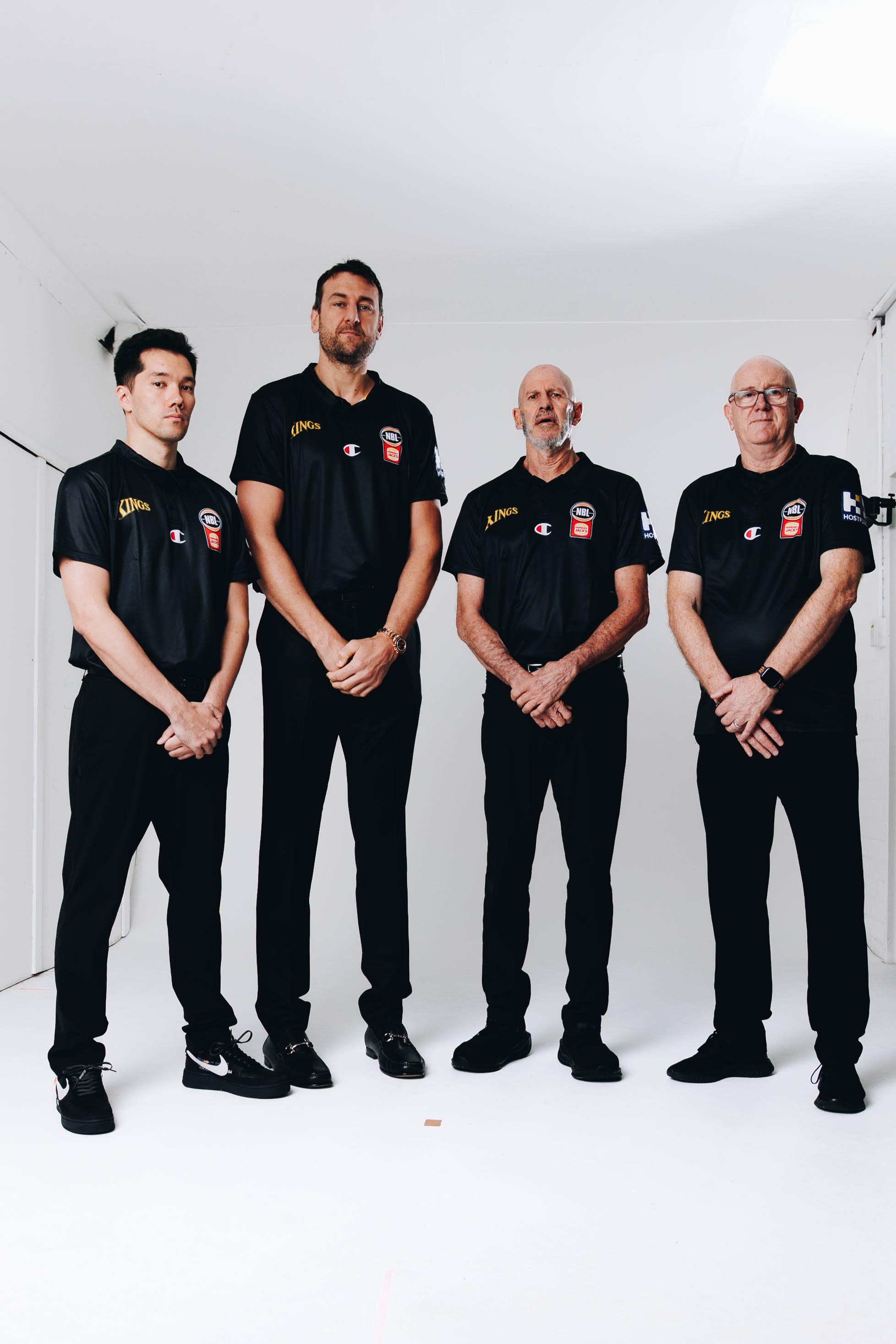
Image: Goorjian with his 2025/26 assistant coaches, L to R: Shaun Roger, Andrew Bogut, Brian Goorjian and Bill Tomlinson. Supplied/Sydney Kings.
Use challenges as an opportunity to clarify your path to success
The Sydney Kings are currently riding a wave of momentum; they’ve won ten games in a row. They’ve found cohesion across their talent-rich roster, their offence is humming, the defensive rotations are crisp and their intensity is dialled up. They’d love to keep that momentum rolling and start the post-season next week, but instead, they need to ride out the FIBA break and reset.
“The huge challenge with the FIBA thing not being a two-week break but a month is that it’s almost like a new season,” Goorjian says.
In discussing how his team will tackle the challenge, Goorjian looks back to how they overcame a slow start to NBL 26 (the team was 3-5 after a one-point loss to Tasmania) and an early injury toll, with both Keli Leaupepe and Jason Spurgin ruled out for the season.
“I said to the group: ‘There’s going to be disappointment ahead, but through that disappointment comes growth if we handle this right and we evolve. That was a reference point through all those early losses.
“There were a lot of hugs, a lot of individual work and video sessions as we moved forward and worked out what was going to be our style. What became clearer and clearer as we played was that we’ve become a team that plays at pace. We’ve become a team that likes to pick [opponents] up at three-quarter court.”
One thing the team decided to emphasise was what they call ‘punchbacks’, points scored directly after conceding a basket.
“There was a style there, and a focus point that we wanted to get better at. We’ve been charting and evaluating that during video sessions, trying to perfect that. Against South East Melbourne (in a fiery Round 20 win), we scored six baskets in the first quarter after they scored.”
“We’ll sit down and revisit how we started, and it’ll be about getting more clarity, knowing our style of play and the areas we need to get better at to step up from where we are now. Our leadership team will be involved in drawing out where the growth needs to be and what we need to focus on during that break, and there will be constant evaluation during that. Then there’s the physical side – conditioning, resting bodies, making sure guys get healthier, and the skill aspect as well. The other thing is to somehow make sure there is competition within that period.
“So, I’m giving you some answers, whether I’m right or wrong, it’s uncharted territory. But you can see that there’s a lot of attention being put towards [that] question.”
Never stop learning
While Goorjian has won six NBL championships and coached the Boomers to a drought-breaking bronze medal, he’s still always on the lookout for new nuances and wrinkles to add to his repertoire. He often watches online seminars from NBA and college coaches. “Now that we’ve got the internet, the world’s your oyster,” he enthuses.
In his early days of coaching, Mike Dunlap, one of his key early mentors, encouraged him to tap into the knowledge of other codes wherever he could. “It started with Australian Rules football; there were a ton of coaches that took time with me, and that was instrumental – guys like David Parkin, Robert Walls, Tony Shaw, Terry Wallace. I learned a lot about things like skill work, team culture and conditioning.”
Embrace change
One cornerstone of Goorjian’s long career, he explains, is getting comfortable with constant change. He’s led an NBL team that folded and been around for multiple mergers. He’s coached the Australian national team, worked with the Chinese and Japanese national teams and even coached in the Philippines, where he led the Hong Kong-based Bay Area Dragons as a guest team in the 2022/23 PBA Commissioner’s Cup.
Given Goorjian’s extensive and successful career in Australian basketball, it’s easy to overlook his long stint in the Chinese Basketball Association, but it was a formative experience that expanded his coaching skill set even further.
“Coming into a Chinese team with imports that were highly paid and with NBA backgrounds was a challenge I was presented with every year I was there. How do you help them and help them help the team? How do you get them to buy in?
“There were elements there where I could really grow and get better. One was communication; I’d be the only person who speaks English through an interpreter. That was a skill set I developed, and I understood how important video was. Not many people sat down with a [player] and showed him a video, said I can help you with a move, and here’s a counter to that move, and you help him that way.”
Invest time and resources to build relationships and recruit the right people
While other coaches eventually become unable to connect with younger generations, Goorjian is still forging strong ties with his young charges, notably Kendric Davis, who is locked in a tight battle with Bryce Cotton for the league’s MVP trophy.
Listening to Goorjian talk about how he built a relationship with Kendric Davis, I was reminded of the stories of Gregg Popovich going to meet the team’s new draft pick, Tim Duncan, and just spending time with him, getting to know him as a person and initially not even talking about basketball.
“One thing I found [that works] is to go to the Summer League, meet with them, their girlfriend, their Mum and Dad, sit down and have a meal with them.
“The mindset with me is ‘no surprises’. We’ll go through everything: the team is like this, where you stay is like this, and this is the paycheck you’ll get at the end of the month.
“When I got Xavier Cooks, I flew to the Philippines and met with him to recruit him to the Kings face-to-face. I started the same way with Kendric. I was with the Knicks (Goorjian was part of the team’s Summer League coaching staff), and flew to Vegas, then had KD flown there. I went through everything with him; we spent four days together in each other’s pockets. It was like: here’s how we’re going to do this, how we’re going to work together. Then, here are the obstacles that are coming, the things that you’re weak at and how I’m going to help you. Then it was hands in, and we had a foundation that we played off from day one here.”
If Sydney is to win their sixth championship this year, the recruitment of Kendric Davis and that meticulously laid foundation will go down as one of the most momentous moves in Sydney Kings history and another storied chapter in Goorjian’s record-breaking career.