

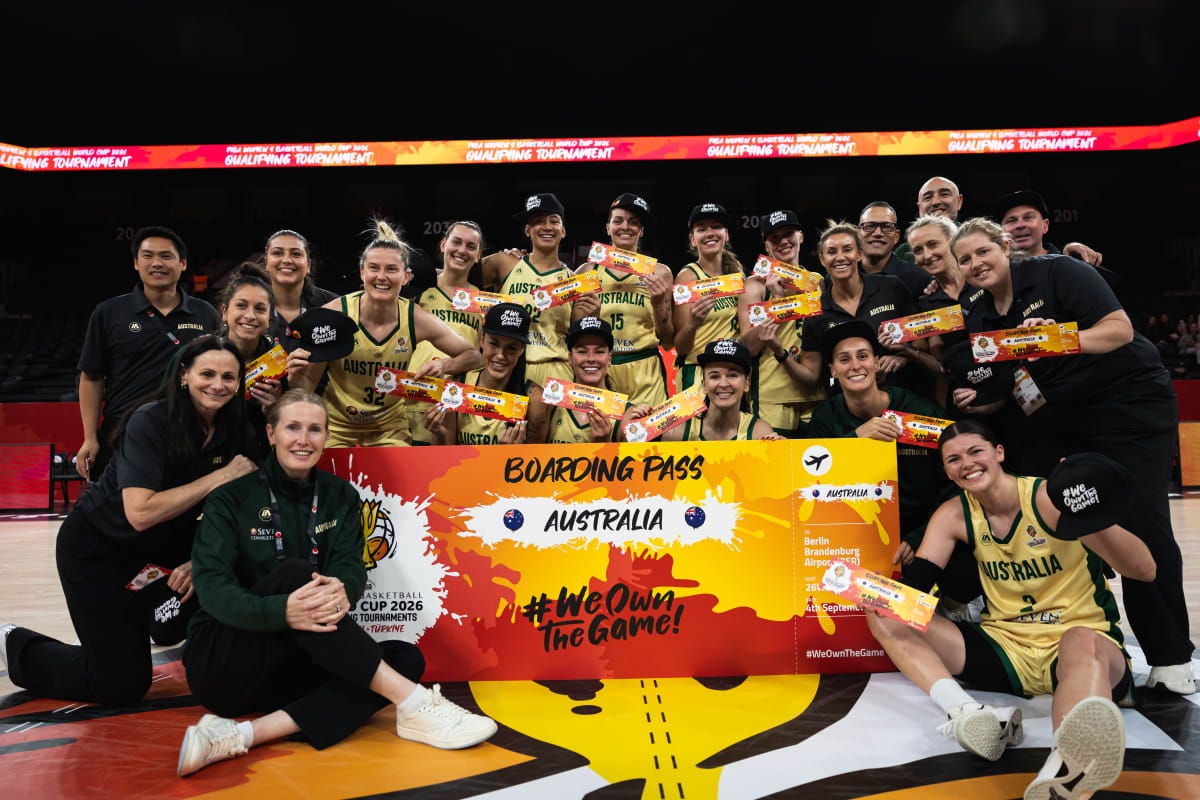
Credit: FIBA
The FIBA Women’s Basketball World Cup is five months away.
The landscape for women’s basketball has changed drastically since the Australian Opals hosted the event in 2022 when they took away ‘rose gold.’ There have been historic CBAs in both the WNBL and WNBA in the past year which reflect a massive boom in popularity. Wind back to 2023 and individuals by the name Caitlin Clark and Angel Reese were key catalysts in this rise, who both represented the United States in their own World Cup Qualifiers which were hosted by Puerto Rico.
Closer to home, the Opals went 5-0 in Turkey even though they were guaranteed a berth to the World Cup, having won gold at the Asia Cup. In between Australia and the US, France and Belgium both also went 5-0. This led to an intriguing FIBA ranking where Australia dropped from second to third and switched places with France. To add another piece to the puzzle, FIBA followed this up by releasing a special edition World Cup power ranking where Australia are second and France are in fourth, sandwiching Belgium.
It’s a mess, it’s mayhem, nothing’s lining up. It’s the chaos that comes with a major tournament like an Olympic games or a World Cup, where one game can make or break a team’s fortunes. All that’s left to do is get back to the cliches and to quote any coach from any sport at any time throughout history: “all we can do is focus on us.”
This is exactly what the Opals did in Turkey, with no better example of this than their opening game against Argentina. It had become a growing trend for the Australian Opals to start a major tournament with a poor performance. In the 2022 World Cup, their first game was a 57-70 loss to France. The 2024 Olympic Qualifying Tournament saw a nailbiter where the Opals were victorious 60-55 against hosts Brazil who ended the group phase at 0-3. In those Olympics, the Opals would lose their opening game against Nigeria 62-75, leading to them being on the ‘wrong’ side of the finals bracket and facing the US in the semi-finals, which disqualified them from having the ability to take away silver or gold.
But it’s a new dawn for the Opals and they are rediscovering their foundation and habits with a new group. They absorbed 4-9 shooting from deep by the Argentinians in the first quarter and still took a lead into the break. The Opals then completely turned off that glacial Patagonian water and slowly but surely turned the game into a blowout. It felt like an unremarkable statement win; as if the blowout was merely a by-product of the Opals sticking to a game plan.
They then faced off against Japan, who officially had their infinitieth elite shooting night against the Opals. Their flurry from deep didn’t let up until the fourth quarter, where Australia decided it was time to turn off Hokkaido’s snowy March water. The Opals dominated the last quarter 23-4 against a team that can get hot in a hurry, turning their defensive mastery into overdrive. This felt symbolic beyond their own gameplan and showing Japan that their fortunes lay in the Opals’ hands was a sort of posturing that isn’t common for Australia on the world stage in any sport. The ability to do this at the drop of a hat was another impressive element.
Against Hungary, Dorká Juhasz was the focal point. Juhasz led the Turkish qualifiers in scoring and rebounding with averages of 18 and nine. This made her a lock to be selected in the All-Star Five. Against Australia, she had her lowest scoring and rebounding game, with seven boards and (checks notes) one point. What’s more is that the Opals only allowed her to attempt five shots, two of which were from deep, and sent her to the free throw line just once. They completely junked up Hungary, holding them to 58 points on 34% shooting, with Virág Takács-Kiss the sole player to reach double figures at 10. Daring someone other than Juhasz to score was a bold strategy and as much of a veteran as Kiss is across Europe, it isn’t in her playstyle to have a scoring explosion.
There were a few key elements that were glaring in these first three games that waned in the fourth against hosts Turkey. Firstly, the Opals played all 12 players. The highest minute total in these games was 28 from Alanna Smith against Japan, where Sami Whitcomb ticked over the second highest with 24. It was a true showing of the big ‘e’ word that the basketball commentariat has fallen in love with in the past half-dozen years: egalitarian.
Next, the Opals were able to get to their game plan. No matter what the approach was and against which opponent, Australia trusted their strategy to best any foe over 40 minutes. This was a great mental win for Brondello and the squad, especially amplified in such an abridged basketball competition. The Opals ensured consistency in execution.
This might be part of the last point, but they won the game within the game. After discovering that their game plan would ultimately end up in a win, the Opals then took care of any side quests that popped up as the game grew on. Whether that was starting strong against Argentina, showing Japan that they were under an Aussie spell or flat out nullifying Hungary’s main source of offence, the Opals had substantial wins that extended further than each game.
This made way for the next game against Turkey. The major cause for concern within this game was the comfortability that Sevgi Uzun was able to get to early on and Kennedy Burke bringing them back late. Australia was routinely late to arrive on Uzun shot attempts in the first quarter, aside from a Steph Talbot block on a jumpshot. There was no resistance and a clear line of sight to the basket on all of her attempts early on. The Opals were able to disrupt her after the first term, but this adjustment probably needed to happen within the first frame.
Burke’s buckets were a little bit less impactful, until they weren’t. She cut the lead to two points with 22 seconds to go after the Opals created a nice buffer in the fourth quarter. There was little resistance offered to Burke and perhaps the first sign of complacency was shown by Australia. These are incredibly harsh criticisms of the Australian Opals, bordering on unfair, yet these are the things to nitpick when you’re a team with aspirations to podium. One mistake early in a tournament has implications down the line.
Turkey also doesn’t possess the same dynamism that teams like Belgium, France, China, Germany, and, obviously, the US do. Italy, Spain and Japan have team systems in place that allow the whole unit to generate momentum, but don’t have the individual brilliance to match the other listed nations. If Turkish players can get going, any of those other teams could snag one from the Opals. Turkey also fell to Argentina, which every other nation was able to take care of comfortably, if not dismantle.
It must also be said that the Opals carried poor health with them into the Turkey game, which included Ezi Magbegor and Chloe Bibby not touching the floor. Steph Reid and Steph Talbot faced various health issues which also impacted them in the game against Hungary the day prior.
Against Canada, the Opals were back to their ways. Heck, they won quarters two and three against Turkey with relative ease. The Canadian team they were facing were fighting for a World Cup berth after going 2-2 in their first four games. Historically, they have been a great basketballing nation but in recent years they aren’t far ahead of the pack. They would be around where Hungary and Japan are, yet definitely better than Turkey, who they lost against in their opening game. Canada’s fortunes are a cautionary tale to every team who made the World Cup, as they missed out on a tiebreaker having finished the qualifiers with a 2-3 record.
In that opening game against Turkey, Canada were down 21-8 at the end of the first. This is where Turkey won the game as Canada were playing catch up the rest of the way. Canada even had a 69-67 lead with two minutes remaining in the game but they had thrown their last punch and ended up losing by two. It’s a game veteran centre Kayla Alexander would love to have back as she finished on zero points and seven shot attempts.
Cometh the moment cometh the woman, and Alexander had left a bullet in the chamber for the Opals. She finished with 26 points on only 16 field goal attempts and 13 rebounds, while co-star Bridget Carleton added 17 points. It was a great showing by Canada and a high character win by Australia who never gave the scoreboard up after it showed 47-47 with six and a half minutes remaining in the third quarter. This was in large part due to a vintage Sami Whitcomb performance who had 23 points on a perfect 5-5 from deep and five assists. This locked up her tournament MVP as she stepped up in the absence of Magbegor and Talbot.
It was a gutsy, professional win by Australia and a great note to finish the qualifiers on. They didn’t rest on their laurels, having guaranteed a spot in the World Cup back in July of last year. Across the 200 minutes of game time, complacency might have crept in for 10 of them, if that. They stuck to their game and controlled the controllables.
Since the last World Cup, the roster has changed considerably. The team in 2022 consisted of perennial features in Lauren Jackson, Tess Madgen, Darcee Garbin, Kristy Wallace, Marianna Tolo, Sara Blicavs, Bec Allen as well as an up and coming Anneli Maley. That team felt like the stars had aligned for the Opals as they arrived at the most suitable unit for the campaign.
Four years later, that sentiment is alive and well. Thinking about the current Opals unit, Tolo is still two months away from her due date which is three and a half months before the World Cup tips off. In recent times, there have been rapid returns to professional basketball from mothers who have recently given birth, such as Kelly Wilson and Napheesa Collier, but that is far from the norm. Tolo would fit right in to this team as a great defensive option backing up Smith and Magbegor, but it’s a near certainty that she won’t be available. The four bigs Australia took to Turkey worked well as a unit and a system and making changes to it would carry a risk. If Tolo were to be added, like a dodgy club, it would have to be one in one out.
Bec Allen has been harbouring a different sort of injury for what feels like all of the 2020’s. She would be another great fit in this Opals squad whose only wings seem to be Steph Talbot and Alex Fowler. A third option here could be a safe move to make considering teams at the World Cup will be bigger than those Australia saw at the qualifiers. A healthy Allen is also close to the best Australian in the world of basketball right now.
Courtney Woods also adds height to the unit at 6’0 while possessing a guard skillset. She has shown an unmatched propensity to just get the damn job done. She might not have experience on the wing at a major tournament but she could be the third option behind Talbot and Fowler while boosting the backcourt height if she were to play at the guard.
Now, of course, these players can’t just join the team, it would have to come with a player being cut, which isn’t the suggestion. This is an exercise in identifying any potential advantages within the margins and Opals fans puffing their chests out, flexing their depth of talent. The suggestion would also be, by process of elimination, that one of Allen or Woods would have to take the spot of a guard that was in Turkey. The question then becomes; do you want five guards and two wings, or four guards and three wings?
Having seen the success in Turkey, what’s known works well. It’s well known that the Opals’ strength is the defensive end of the court, which leads to transition opportunities that guards optimise. The team also leans on ball movement and clean looks rather than individual scorers, which also relies on guards and great playmaking. The Opals have this in spades. Having Steph Reid as a depth piece to be a steward of the offence, dictate the pace and make the opposing point guard’s life a nightmare is a luxury most other nations can only dream of.
The inventiveness, which is actually a real word, from the Opals backcourt is a huge competitive advantage. Putting the US aside and looking at France and Belgium, they have great guard play but not without their limits. Starting with Belgium, they have the second best starting five behind the US without any shadow of a doubt. Julie Allemand and Julie Vanloo are efficient playmakers and shooters, with Allemand hanging her hat on her ability to give away little to no turnovers. It’s been hard to place where Emma Meesseman ranks as a basketball player as she’s spent the past few years in Europe and foregone the WNBA, but if she were American she would walk on to the US roster. Kyara Linskens is listed at 6’4 but plays a little taller than that, maximising her length and size. She has an ability to spread the floor and protect the rim to a high degree making her an ideal candidate at the five in modern basketball, especially next to an elite unit.
Australians might remember Antonia Delaere as the player Steph Talbot iconically blocked to save the bronze medal at the 2024 Olympics. Ironically, those players make great comparisons to one another, with Talbot simply a better version. Delaere had a great qualifying campaign but on the bigger stage her production isn’t something the Cats rely on. After that, there’s quite a drop off to their rotation pieces. Brondello was masterful in making their Olympic meeting a 40 minute slog that necessitated depth and this Opals unit is just as well suited to do so.
This will also be key against France, who have some size that could cause issues for Australia. Gabby Williams is a bigger guard and athletic, which is a matchup nightmare for the Opals. Standing 6’2, Janelle Salaün is a three level scorer who oscillates between the gaps that this French team generates organically. She seems like a task for Talbot, but there will need to be help on guards like Williams or Marine Johannes. The court is Johannes’ easel, flying around making no look passes or pulling up from wherever and whenever at the three point line.
Then there’s Dominique Malonga, born a year after Victor Wembanyama and possessing a similar skillset, yet much more raw. At 6’6 with a 7’1 wingspan she stands taller than most players she will come up against in the World Cup. She has the ability to stretch the floor but understands her weapons and first establishes herself on the inside, while swatting away everything on the other end. On a fastbreak in France’s qualifier against the Philippines, she got out and made a dunk look like light work.
The mix of Johannes, Williams, Salaun and Malonga at the same time makes defending them near impossible. It’s likely most opponents lose the matchup against France here, but if the Opals can make it a slog like they did against Belgium, that’s the formula. Once the armour of that core is pierced, it all starts to unravel for France. Three-and-D role players like Mamignan Touré are deadly and compound the issues that France cause, but they can equally take them away if the team isn’t in a rhythm. Marine Fathoux and Iliana Rupert also didn’t make it to the qualifiers due to injury and the latter is a sure fixture for the World Cup if she’s healthy.
One through seven, France is probably even with Australia, but, again, the Opals will need to ensure they use their strength in their depth. The Opals also have better coaching and if Brondello can win this battle early, Jean-Aimé Toupane is often criticised for not having a plan B. The blueprint to beating France will be a similar game plan to that against Belgium, no complacency from the Opals and sticking to their own gameplan. These are things that the Opals laid the foundation for in their World Cup qualifiers.
At the pointy end, the world of women’s basketball hasn’t been this strong in a while. On the other hand, that next tier down from that fifth to twelfth spot feels like it hasn’t been this weak in a while, which could be in part influenced by how far ahead the top four teams are. This might be crazy to say, but the US even seem a little weaker than we’re used to seeing. Their frontcourt talent is incomprehensible as it always is, but there has been a changing of the guard in their backcourt. The US team of old had a backcourt that set up the frontcourt, but this new crop, headlined by Caitlin Clark and Paige Bueckers, lead with their scoring. They might have to adjust to this dynamic shift on the fly. Even still, they’re still better than every other nation by quite the margin.
The Opals are the most successful sports team in Australian history. A legacy of greatness that has been upheld for three decades and has shown no signs of slowing down. Spain has risen and fallen, France has figured themselves out, Belgium has had this golden era, Russia has…
All of these things have bobbled up and down, but Australia has remained at the top throughout it all. They are, again, suited to find themselves at the end of a major tournament with a medal around their necks.
How they get there will be the story to watch in Germany.
Bi-annual please for a Green v Gold charity televised intra-squad exhibition game at Opals' next pre-event training camp ...