
Inside the rise of Melbourne's streetball
With a curtain call for Melbourne's summer of streetball, we look deeper into its growth over the past 15 years.

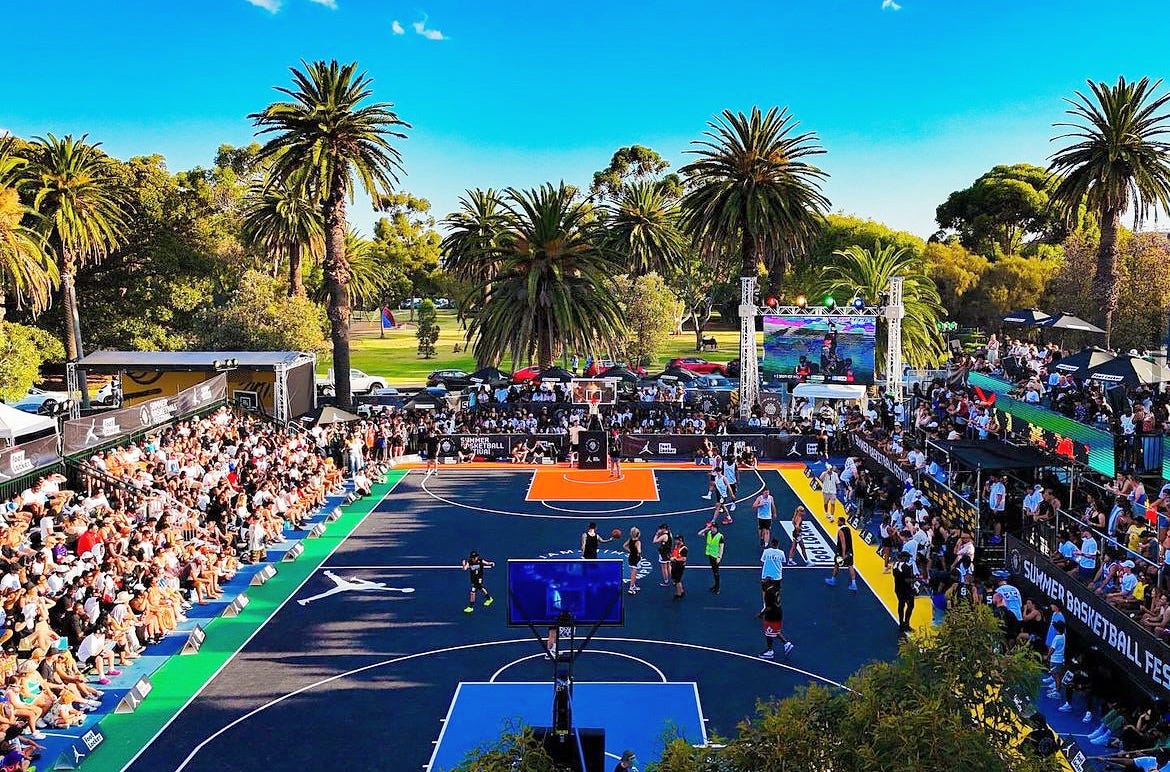
Credit: MSF Sports
“Peanut Farm [Reserve], historically, has had no community,” Pascal Ducasse told The Pick and Roll recently. “There’s only the small blip of [COVID-19] where it had a community of people playing there. Outside of that, there’s never been consistent [basketball] runs in 28 years of living there.”
It felt like serendipity when Pascal, who grew up around the corner from Peanut Farm Reserve, St Kilda, learnt that his workplace had landed the Summer Jam contract.
“I work for this company and we’re the people that did the courts for it. So I built the courts. I worked on them here in the warehouse and then setting it up there. It’s just a coincidence that I went to primary school with Eamon and Daniel.”
The two friends he speaks of, namely Eamon Larman-Ripon and Daniel Ella, are the masterminds behind Summer Jam, the annual streetball tournament that has built a strong following through the years. Summer Jam, née Prahran Summer Jam, began in 2012 and was played at Prahran Park, which has gradually been transforming into Prahran Skate Park.
Those courts possess a binding charm and Ella mentioned it was never Summer Jam’s intention to move away from Prahran, but cited safety concerns from the council. “When we had it in Prahran we had to close the fence in the late afternoon. You still had people jumping over the fence, which, I don’t know, is obviously a part of the character of it all. But we have to ensure that there’s a venue that can hold our people safely.”
Summer Jam’s spiritual home remains at Prahran, but Ella understands that Peanut Farm can “hold thousands of people as opposed to hundreds.” This growth continues to be seen by the streetball, basketball and now wider Australian community.
“There’s only so much we could have done. I mean, we even had our branding this year as the church theme. That was because we have to make all our brand themes a year in advance for Nike and Jordan to approve. So we were gonna go back to Prahran with our church theme.”
As much as Ella and Larman-Ripon wanted to stay at Prahran, the journey made sense. “Peanut Farm and Prahran were synonymous to our upbringing so both are quite meaningful for us. Seeing where it is now, we never expected Drake or Lance Stephenson to be there. We put this on for our community and now it’s sort of become a place to meet the who’s who.”
It’s been a collective effort, and one that landed Ducasse at the centre of the move to Peanut Farm. “I’m probably the one person in the world who’s played there more than anyone ever, which is a crazy stat,” he said. “It really feels like my home. It’s surreal, honestly, to see people showing up at that court because no one plays at Peanut Farm. I can’t emphasise that enough.
“It’s surreal and it’s beautiful. It’s such a beautiful setting for court. Especially now that the courts are blue, although that’s only been like maybe five or six years. So it’s like blue court, green palm trees everywhere, you’re 100m metres from the water. It just felt like you’re in LA or something.”
Pas also comes with his own basketballing abilities, with an acumen for three-point shooting that landed him in a certain A-grade team at the Melbourne Sports and Aquatic Centre (MSAC). As he tells it: “One of my mates hit me up and was like, ‘Drew’s in Sydney right now and we need some shooting,’ so I joined them. This is back when I was hitting like three or four threes a game, nowadays it’s a little different.
“So I was playing well but we weren’t winning and they were like ‘when Drew comes back we’ll get some more wins,’ and I was like who’s this Drew guy?”
‘Drew’ turned out to be Australian basketball legend Andrew Gaze. When he returned from his trip to Sydney, sure enough, the wins started piling on. But how did Pas, without any background of organised basketball, end up being Andrew Gaze’s injury replacement? Passion, time and energy have been the nucleus of Pascal’s relationship with basketball since the beginning.
“I went with my brother or I went by myself and that was 99% of times that I’ve been to [Peanut Farm]. So that, first of all, grew my love for just shooting by myself. The second thing, the second big thing was that I was not particularly athletic. I was the short, chubby, could barely make it up the court kid that had like good aim or whatever. When I’d go to the court, I wasn’t dribbling or doing layups. I was there for an hour or two just shooting.”
Passion was where it all began for Summer Jam too, as Ella shared. “No one was really doing events and we saw our dreams of being professional not being as realistic as we had hoped for. We started a tournament of eight teams and had a $500 cash prize.”
It has since flourished into an unmissable event, attracting the likes of Lance Stephenson and Drake, but it isn’t the only streetball tournament on show during Melbourne’s summer.
King of the Court (KOTC) has emerged as a must-see event that showcases three-v-three basketball. While the two sound similar, it’s not to be confused with 3x3 basketball - primarily a FIBA product that operates under structure and governance, including a shot clock and a smaller size six ball that has the weight of a size seven.
KOTC organiser Mitchell Lang categorised the difference for us over a chat recently. “3x3, that’s a FIBA game. To a tee it’s still organised basketball. 3x3 is organised basketball, it’s not streetball, it’s like five-on-five.”
Although 3x3 might have been born out of the idea of outdoor basketball, it speaks volumes that no streetball competition incorporates it. As an organiser of such a competition, Lang explicitly stated that it wasn’t recognised as streetball. He would go on to discuss KOTC’s origin story, which was similar to Summer Jam.
“It’s such a dope court, it’s in the park, there’s chain nets, like, man, there needs to be a tournament here. Growing up I’ve been to Summer Jam and it’s really dope. I really wanted to do my own thing and I wanted to do three-v-three. I just thought, man I’d love to start something where, one, I can play, because I wanna play in it and I wanna hoop. This is dope, I love the area, I’m always here anyway. So I’ll just start an event and call it King of the Court.”
What started as a three-v-three competition has grown to include a one-on-one tournament, dunk contest and freestyle cypher, won by none other than Pascal Ducasse last year.
Lang built on his basis for KOTC’s inception. “I just wanted to create an event there which was just for me and my immediate friends. It wasn’t like I was trying to make it into a big event and have international and interstate teams or anything like that. It was 40 bucks a team to play and I gave out 300 bucks to the winner and we had 12 teams. If you do the math I don’t think I even made 500 bucks in team rego.” He then added, through a smile, “it was just a grassroots event, you know?”
Lang’s passion is palpable. Although the plan wasn’t to go global, it might have been inevitable. He recorded a promo video with Nick Kyrgios as well as partnering with his brewing company, Stryda, among a host of sponsors in Ford, Champion and Reebok. What started as grassroots basketball event in Carlton Gardens has attracted brands and sports stars who are household names. It’s turned into a global competition that symbolises the beginning of Melbourne’s summer screening: streetball.
“It’s about putting on a show. That is the heart of anything,” Lang stated. “When do kids go wild in an organised basketball game? When someone dunks the ball. When someone does something where there’s showmanship. Streetball has that in oodles. Everyone wants to put on a show. Everyone wants to be him. Everyone wants to be her. Keeping players as the main central experience is so important and having players that are able to put on a show and are able to play is great.”
As much as it’s about the highlights, Lang dove into the core of the experience. “Streetball is all about chemistry, at the heart of it. You’re playing basketball with your mates. There’s not coaches, there’s not nothing. There’s no training, you’re playing with your mates. It’s about chemistry.”
That’s as pure as basketball gets. Everything is stripped back to the absolute essentials. As much as streetball is about showmanship, it’s about selflessness. It has stayed true to itself and has bled into the NBA more and more over time, even when the NBA actively tried to outlaw forms of self expression.
“They wore tight shorts up to there,” Lang gestured. “It wasn’t about culture or street or looking cool. It wasn’t tattoos, braids, nothing. It’s the way that the street culture has impacted basketball in that way. Now you see Steph Curry shoot the ball, turn around, not even look at the rim. You see these people at the highest level have a bit of flair, have a bit of flash.”
Lang’s right. Streetball has remained largely unchanged, with traditional, organised five-on-five basketball leaning closer to the street rather than the other way around. At the core of it, it’s about acceptance and self expression, something Lana Hollingsworth has in spades, as she shared with The Pick and Roll recently.
“The big thing about the streetball culture that I loved from that first Summer Jam was that I was allowed to be loud, I was allowed to talk shit. I was allowed to do celebrations,” She shared. “I was allowed to dance. I was allowed to talk to the emcees. It just felt a lot more open and it felt a lot more free.”
Hollingsworth came up through very traditional pathways. She represented Victoria and Australia en route to an NCAAW career. The Summer Jam she competed in was the second she attended, following a season as a DP with the Southside Flyers.
“That first year I was playing with the [Southside] Flyers and a few of us went down to Summer Jam. I just remember being there and being like, oh my gosh, this is so sick, this is so fun. At that time, they only had Red Bull half court for the girls, but we couldn’t [play] because we had the game at John Cain Arena for LJ [Lauren Jackson]. I remember going like, this is dope, I want to play this, I’m going to do everything I can to play this.”
She continued, “then next year I got into med school. So I knew WNBL was probably off the cards. I wasn’t really trying to pursue a spot anywhere. Because of that, I had the summer off, essentially. Then Summer Jam announced the girls were playing and they announced the same prize money. And I was like, oh, I’m locked in. Like, $20k! So I organised a stacked team.”
Med school being thrown into the mix is a real game changer, but it represents the ethos of streetball. Come as you are, if you can ball, you can ball. “It’s not the most conventional combo,” Hollingsworth declared.
“People [in med school] are just impressed that I’ve played professional sport and now manage to still play basketball in med school because med school is obviously very time consuming. There is a bit of code switching, obviously, between streetball culture and talking shit and then being in a very hierarchical profession where you have to be very professional.
“I would say the overall impression from both parties is that they have the same reaction, just reversed. And then there’s the occasional basketball person that tries to ask me for medical advice and I’m like, no, not here.”
Hollingsworth perfectly fits out within the community of streetball. She’s a great example of how it’s a space for people to come together, celebrate their differences, express themselves and showcase their abilities.
Ella touched on this as an added motivation for Summer Jam. “It really came from the community of hoopers and it was just purely because we loved it and there was obviously a need for it. Especially for the players that put in the 10,000 hours but don’t get to play in front of a crowd or don’t get to play for money, so this is the opportunity to do so.”
Although Hollingsworth has been on huge stages in two D1 US schools and the WNBL, they don’t fit into her plans right now. “I really think streetball is the thing that allows people like me to keep playing basketball. I very much knew I always wanted to do medicine. That was the dream and I’m very happy I’m doing it. At the same time, I still love basketball. Streetball definitely allows you to be flexible. There’s like four or five tournaments over the summer where you can win money.”
These tournaments have exponentially grown in popularity and prize money. 41-year-old Joey Mausar has seen this grow from nothing and played a large role in ushering the space before any of these tournaments existed. He’s been a fixture at Summer Jam, KOTC and played in the Iso 1v1 tournament just a month ago. As Pascal said - “he’s the OG.”
Mausar detailed his interaction with streetball throughout his life with The Pick and Roll in a recent interview.
“I was probably playing in the parks from about nine years old, but didn’t really understand streetball culture until I was in my late 20s,” Mausar shared. “So we’ll start that from, say, 27 years old, because that’s when I started hooping outdoors a lot more regularly. The freedom of expression that you have out at a park without a coach, without a ref, without someone’s parents impacting the way that you view how you play can really put you in a negative headspace.”
He applied his experience on how potent the impact of it could be on kids today. “I think that plays a big part in why kids in today’s era have that a little bit more urge to go outside and play streetball because they’re enjoying it. They’re getting to express themselves in a way that they probably can’t really do with their local comp or their rep squad.”
Streetball addresses the lack of self-expression and freedom kids might experience during organised, club level basketball.
“My first instance back on a court after having that seven years off was at a street court in Prahran, and that kind of led into me doing that every Sunday for the next 15 years. It’s my home, I love it.”
Mausar presented his connection to the Prahran courts in an authentic, humble manner, completely juxtaposing how Pascal approached it. “You gotta talk to Joey about Church Sundays,” Ducasse exclaimed. “There’s a bunch of NBL1 and Big V type players in there. In Prahran, you gotta be good to play.”
As understated as Mausar was about Church Sundays, they were played at the court where Prahran Summer Jam planted its roots, with the finals being played on the Sunday. Church Sundays preceded this by two years, a community Joey was entrenched in. Whether it’s at Prahran or Peanut Farm, Mausar understands how special it is.
“It’s awesome for me on a personal level, because when I was growing up, we never had stuff like that. Either you’re playing domestic, you’re playing rep squad, you’re playing state, or you’re basically just, you know, playing at a park with a couple of your mates and cousins and that was it.
“Now there’s all these different platforms where people that have real talent, real skill, get to showcase their ability on those platforms. And it’s respected from basketball players all over the country and internationally.”
No one has seen the rise of streetball more intimately than Mausar. He has been a true pioneer of the space, helping steer it on its path of self expression. Streetball’s rise has coincided with the rise in popularity of basketball in Australia, but they might not have been hand in hand for the full journey.
“I would say that they’ve probably gone down separate paths, but they’ve come together at the end,” Mausar said. “I feel like even through my community of streetball here in Victoria, there’s a lot more kids that are involved in NBL. They go to the games, they want to see the players, there’s a lot more interaction on social media. When I was 19, that wasn’t going on at all. Maybe you’d watch one game a week on TV because that’s all it was. You didn’t really feel connected to the game too much.”
Connection and community seem to continually come up for everyone’s rise with streetball. There’s also a very strong connection to the setting. Without prompt, organisers, players and fans will naturally bring up the physical environment in which streetball takes place in as if it’s a character you can converse with. No matter how much two teams or two players might hate each other, they’re linked by a greater, connective, communal force. The court and the sun are their religion.
There’s also a refreshing concept with streetball, which is that everyone who’s involved, from players to organisers to the people that build the courts, play basketball. Major basketball leagues would only have a fraction of its decision makers having played basketball, and they wouldn’t be seeking this out as a prerequisite. With streetball, you don’t just play basketball, you’re often above the average basketball player.
In the US, streetball has been around for over a century, and some competitions are older than the NBA. In Europe, formal competitions have been around for nearly 40 years and it has lived informally for even longer. Japan is coming up on two decades of streetball competitions, so Australia feels like the youngest sibling in the space. It also speaks to the fact that wherever there’s good basketball, there’s good streetball.
Ducasse, Ella, Lang, Hollingsworth and Mausar are all bound by their love for basketball. They’re all honest, self-possessed and genuine. There’s no space or time for anyone to be fake in streetball, it’s immediately detected.
Lang says it best.
“There’s a whole other side of basketball, as an expression of passion, where you don’t need people breathing down your neck. You don’t need to worry about getting subbed off. Or, ‘oh, I shouldn’t have put it through my legs.’ It’s like, hey, you rock up, you make a bad shot, don’t worry, the crowd will let you know about it. You make a bad shot, your teammates are gonna let you know about it.”
Streetball is laden with basketball purists. With November around the corner, Melburnians are spoilt for choice. Whether it’s five-on-five, three-v-three or one-on-one, there’s something for everyone. Proportionately, you’re in store for unprecedented highlights which are built on a foundation of utter chemistry.
Streetball continues its rise, and it’s not waiting for anyone.
I attended the Summer Jam in 2016, which was absolutely epic. Unfortunately, my team lost in the championship.
Fantastic experience and one I'll never forget!