
Five takeaways from the Australian Boomers' World Cup qualifiers
It can be easy to gloss over the early stages of World Cup qualifying window games, but a pair of Trans-Tasman clashes gave us plenty to enjoy.

1. National team returns to Tassie
It took almost 20 years, but the Boomers were finally back in Hobart on Friday night. The national team last hit the court in Tasmania back in July 2006, again taking on New Zealand in game three of a hard-fought four-game series for the Al Ramsay Shield. While veteran Jason Smith led them to a one-point win in overtime, the squad dubbed the “Baby Boomers” featured future stars like Andrew Bogut, Chris Anstey, David Barlow and Brad Newley; they would ultimately lose the series on point differential, then flame out with a 13th-place finish at that year’s World Championships.
Their return to the Apple Isle was just the first step on the road to the next World Cup in 2027, but the going wasn’t any easier this time around. The JackJumpers fanbase is among the NBL’s most rabid, but they weren’t quite at full voice as the Boomers struggled to find their feet early and trailed by seven at half time. Maybe they needed time to warm to the idea of cheering for players that are normally the enemy? Maybe FIBA’s lack of non-stop blaring music, while a welcome change for yours truly, threw them off?
Whatever it was, they shook it off to help bring the Boomers home in a tough and tight second half. While it wasn’t a sell out crowd, you wouldn’t have known when the shots started dropping late, and although it wasn’t quite the same roar as at a big JJs win, it was a warm welcome back to the state. The biggest reception, though, was for their “hometown” heroes – both Josh Bannan and Ben Ayre have only been JackJumpers for a few short months, but they received raucous applause every time they checked into the game.
Bannan battled manfully against a talented New Zealand front line but was limited by fouls, racking up six in less than 15 minutes of play across the two games. The debut of Ayre was the feel-good story for the home fans, though – five years removed from working in a Melbourne warehouse and considering retirement, the 29-year-old wore the green and gold for the first time and didn’t look out of place. “A big step for Ben Ayre to put on this jersey this week, and I thought he had some really good looks… his tenacity and the way that he plays, it’s going to be so needed,” Boomers coach Dean Vickerman said after game one.
2. Big Shot Davo continues to shine
Davo Hickey is no stranger to big moments, as Vickerman knows all too well. After all, it was the coach’s Melbourne United squad that copped the full force of Hickey’s breakout last season as he led Illawarra to the NBL title. “Davo just beat me in a grand final,” Vickerman said with a smile after the win in Hobart, “so it was nice for him to make a big three ball to go four up at a key moment in the game.”
Credit: FIBA
Before that, it was the South East Melbourne Phoenix and Angus Glover that were bested by Hickey and the Hawks in the semi-finals. “Davo, he’s so poised out there… I feel like he’s got so much time in every on ball he’s in,” Glover said. “I just love watching [Hickey and Jaylin Galloway] play, and I love that they’re on my team this week.”
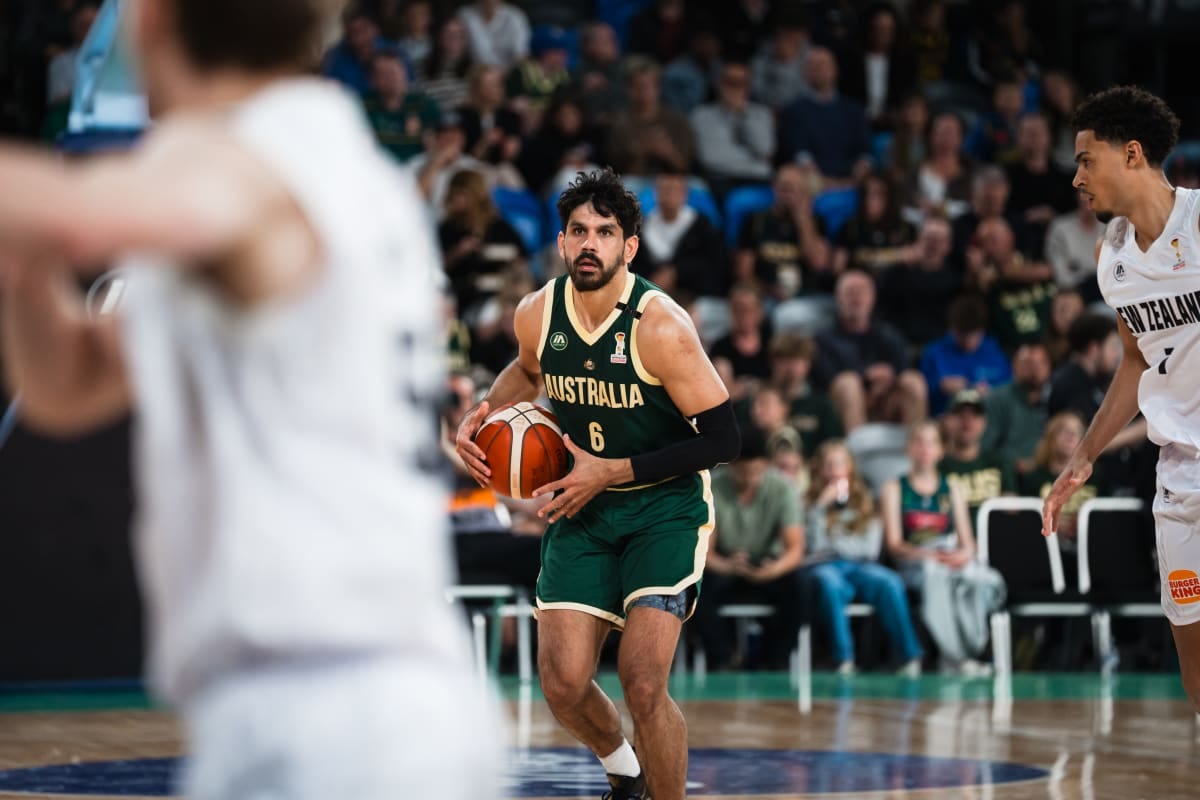
The Boomers got the full Hickey experience across two games, for better and for worse. He ran the offence superbly for long stretches, methodically working around screens, then picking his moment to attack the basket or zip a pass to the open man. At other times, though, he was the Davo of old, trying too hard to push the tempo and flying out of control as a result. Across both games, his 13 assists led all players, but so too did his 13 turnovers; game two was on the verge of becoming a disaster, with his seventh and eighth turnovers coming in a fourth quarter that saw the Tall Blacks storm to a double-digit lead.
All of those ups and downs were forgotten, though, as he stepped up and made the defining play of both games. In Hobart, it was the triple that pushed Australia’s lead out to four with less than 40 seconds remaining, finally putting a tough contest on ice. A broadcast malfunction robbed Aussie fans of the end of game two, but it was even better – an off-balance banked three to beat the final buzzer and give the Boomers a two-point win on the road.
Hickey was typically understated in the post-game press conference, giving credit to the team’s bigs, their bench unit, and the coaching staff without ever even mentioning his game winner. He can no longer dodge the hype, though, having turned his grand final heroics into consistent brilliance with Illawarra, and now following on from a strong campaign at August’s FIBA Asia Cup with more brilliance for the national team. It can still be a rollercoaster ride at times, but the Boomers will gladly ride those ups and downs with a player that looks set to become a staple of the program.
3. The next generation of Boomers?
As Australia’s presence in the NBA has exploded over the last two decades, the Boomers program has changed. With a few players as exceptions, the national team has been represented by two distinct squads – the group that plays in these qualifying windows and the Asia Cup, and the full-strength side that is sent to the Olympics and World Cup.
A changing of the guard is looming, though, with Joe Ingles (38 years old), Patty Mills (37) and Matthew Dellavedova (35) almost certain to be aged out by the next World Cup in 2027. As the Boomers now look to build around rising stars Josh Giddey and Dyson Daniels, there’ll be openings there for some fresh faces to step into; these qualifying windows might be easy to gloss over, but some promising performances would have surely caught the eye of regular coach Adam Caporn as he starts to plan ahead.
At the top of his list would be Jaylin Galloway, who, like Hickey, continued on from an excellent showing at the Asia Cup. After claiming tournament MVP honours there, he was again Australia’s best player, leading the team in scoring at 16 points per game while shooting 46.2% from three and, incredibly, 100% from inside the arc. In a series where both games were close until the dying seconds, the Boomers were plus-19 when he was on the court.
At his best, he’s exactly the kind of player that the Boomers have been lacking in recent major tournaments – a knockdown shooter that can play with or without the ball and defend at a high level. Those types are doubly valuable alongside Giddey, a preternatural passer always looking for shooters and cutters, and Daniels, a growing playmaker, but one that can struggle to make shots.
He showed off that full package against the Tall Blacks, making shots off the dribble when defenders went under screens, then punishing hard closeouts once they adjusted. It was an impressive bounceback from a slow start to the NBL season – widely tipped as the frontrunner for the Most Improved Player award, he’s struggled to lock down a consistent role for Sydney and is shooting 41% from the field. He seems to be a different beast in the green and gold, though, and this version of him could easily slot into a star-studded Boomers lineup.
“JG, some of the stuff he does I’m like ‘I wish I could do that!’” Glover said after Galloway scored a team-high 19 points in Hobart.
Glover might not have the highlight reel to match Galloway, but he too made his case as a left-field option for the future. With the Boomers caught in a slugfest and trailing at half time in Hobart, he single-handedly shifted the momentum early in the third term, making three threes in the first two and a half minutes to break the game wide open. He finished the game with 17 points, 14 of which came in the second half as Australia stormed home.
It was just the latest hot streak for the 27-year-old, who sits in the top five in the NBL for made threes despite being the only player in the top 20 to not start a game. “I put in the work every single day with my shot, so I’m always confident going out into a game,” he said of his recent form. “It is what it is, I’m happy to shoot the ball, but at the same time I really don’t care, we got the W and that’s all that matters.”
The Kiwis adjusted their game plan in Wellington, and with a clear mandate to restrict Australia’s shooters, Glover was scoreless with just four field goal attempts. His presence still opened up lanes for Australia’s bigs, though, and he found ways to make an impact regardless, flying around the court defensively and racking up five steals. Even a down game showed what his value could be to the Boomers long-term – still a plus athlete even after three ACL tears, he’s the type of low-fuss three-and-D guard that the national team has been crying out for.
Making it to a World Cup or Olympics is a dream, and it would be an incredible story, but it’s not something he’s chasing in the here and now. “Yes that’s the pinnacle and that’s every kid’s dream, absolutely, but just worry about the daily process of how that looks to get there and keep performing,” he said after game one.
“Keep having fun with it as well, I think that’s the biggest thing… I think you’re playing your best basketball when you’re having fun, and yeah, I feel like I’m having a lot of fun right now.”
4. Boomers bigs put to the test
As soon as New Zealand’s squad was announced, it was clear that Australia’s bigs would be tested. With NBL stars Sam Mennenga and Tyrell Harrison joining forces with former Breaker Yanni Wetzell, the Tall Blacks had three world-class bigs at their disposal. When Boomers centre and captain Will Magnay was ruled out through injury, the challenge only grew.
For long stretches of both games, it was too much for the Aussies to handle. At half time in Hobart, they were being outrebounded 23-15 and outscored in the paint 28-16; through three quarters in Wellington, the rebound count was 40-29, with New Zealand scoring 20 second chance points as a result. With Bannan battling foul trouble and Jordan Hunter barely used, the Boomers were constantly fighting an uphill battle around the basket.
That made the fightback in both games even more impressive, and while New Zealand’s bigs were still prolific, the Boomers were able to break even in the key moments. They held the Tall Blacks to 30 points in the second half in Hobart by giving up just six points in the paint, with their bigs flying across the court to contest rebounds and swatting five of their six blocks after half time.
“The Boomers were very physical, pushing us out of our stuff, our cutting and things like that in the second half… They made some plays, they tipped the ball off, they made some blocks,” New Zealand coach Judd Flavell said after the game.
It was a similar story in Wellington, where they knuckled down late to overturn a ten-point deficit early in the fourth quarter; from that point on, they outrebounded the home side 12-7, including three big offensive rebounds leading to buckets. “It was our bigs today… [when] I thought the ball was over my head or over someone’s head, they just came in and cleaned it up, helping us with our mistakes as guards,” Hickey said after the win.
Leading the way, as he has for so long, was Nick Kay, who stepped in as Boomers captain and stepped up in a big way. Kay has done it all for the national team, including multiple World Cup and Olympic appearances, and yet at 33 years continues to make himself available at every opportunity, no matter the opposition or the occasion. “It doesn’t matter where it is in the world, he’s willing to sacrifice and drop whatever’s going on in his world and play them,” Vickerman said of the veteran forward.
“He’s someone who’s been to the best tournaments in the world and keeps coming back and leading and teaching, and that’s what this program keeps striving to be.”
That leadership is a plus, but his production on the court was every bit as important. He was the driving force in their late comeback in Wellington, racking up 10 points, three offensive rebounds, an assist and a steal in the fourth quarter alone; in Hobart, he did a little of everything, tallying eight points, eight rebounds, two assists, two steals and two blocks. He’s become a divisive figure among Boomers fans in recent years, and yet he continues to do all of the little things that power winning, taking on tough defensive assignments, switching and scrambling like crazy, and crashing the glass against bigger opponents.
The other key was Keanu Pinder, who fouled out in Hobart, but not before setting the tone with his frantic defensive energy after half time. He then led the way on both ends in Wellington, keeping the Boomers afloat offensively to finish with a game-high 21 points, and covering more ground than anyone defensively to paper over any cracks, racking up five blocks in the process. It was a welcome return to the national team, with Pinder’s last appearance in official FIBA competition coming in 2023, and a timely reminder for those in Australia of what he can do at his best.
5. New Zealand is building something special
The Tall Blacks are more than deserving of a quick shout out here, despite falling short in both games. Across their last three clashes with the Boomers, going back to their home win in May’s Trans Tasman Throwdown, they’re ahead by two points; a pair of narrow losses here takes some of the shine off, but it’s a big step in the right direction for a team that has historically struggled against their neighbours.
“That was a really good quality New Zealand team that they put on the floor… still a couple of pieces for them to add, they put a really talented team out there,” Vickerman said after the second game.
The talent level in the country has been rising for years now, but the toughest step can often be getting buy-in from those players. It doesn’t seem to be an issue here, with a supremely talented group making themselves available for the qualifying window. Off the back of a solid campaign at the Asia Cup, led by high-level NBL talents in Flynn Cameron and Mojave King, they welcomed back Harrison, Mennenga and Wetzell for their first games of the year.
“I think it just shows the connection that we have, they always want to put on the black and white singlet,” Tall Blacks guard Izayah Le’afa said of their return. “It’s an amazing opportunity and you don’t really get to represent your country too much, so every chance you get, you’re grateful and just blessed to be able to do that.”
The end result was a team with a clear identity, built around that trio of bigs and their overpowering presence in the paint and led by the rapidly improving Mennenga. Already the early favourite to be named the NBL’s Most Improved Player, he averaged 17.5 points and eight rebounds in just 18 minutes per game to be New Zealand’s clear standout. Most obvious was the confidence he played with – he’s shooting the ball without hesitation, attacking off the dribble and in the post, and finishing at the rim no matter who’s in his way.
The other standout was Cameron, who ran the offence as the lead ball handler for long stretches, something he’s done for Adelaide this season but that was fairly foreign previously. Just as his father Pero was during the glory days of Tall Blacks basketball more than two decades ago, he looms as a leader that they can build around into the future. “Our connection is everything for us, and whenever I talk to these guys he’s one of the first just to put his hand up… it’s great for his continued development, and I’m sure his best is yet to come,” Flavell said post-game in Hobart.