
Defence and determination: How Australia claimed bronze at the U17 Women’s World Cup
Youthful talent like Madi Ryan, Olivia Olechnowicz and Isabel Smith starred as Tom Garlepp’s team edged out Canada for a podium finish.

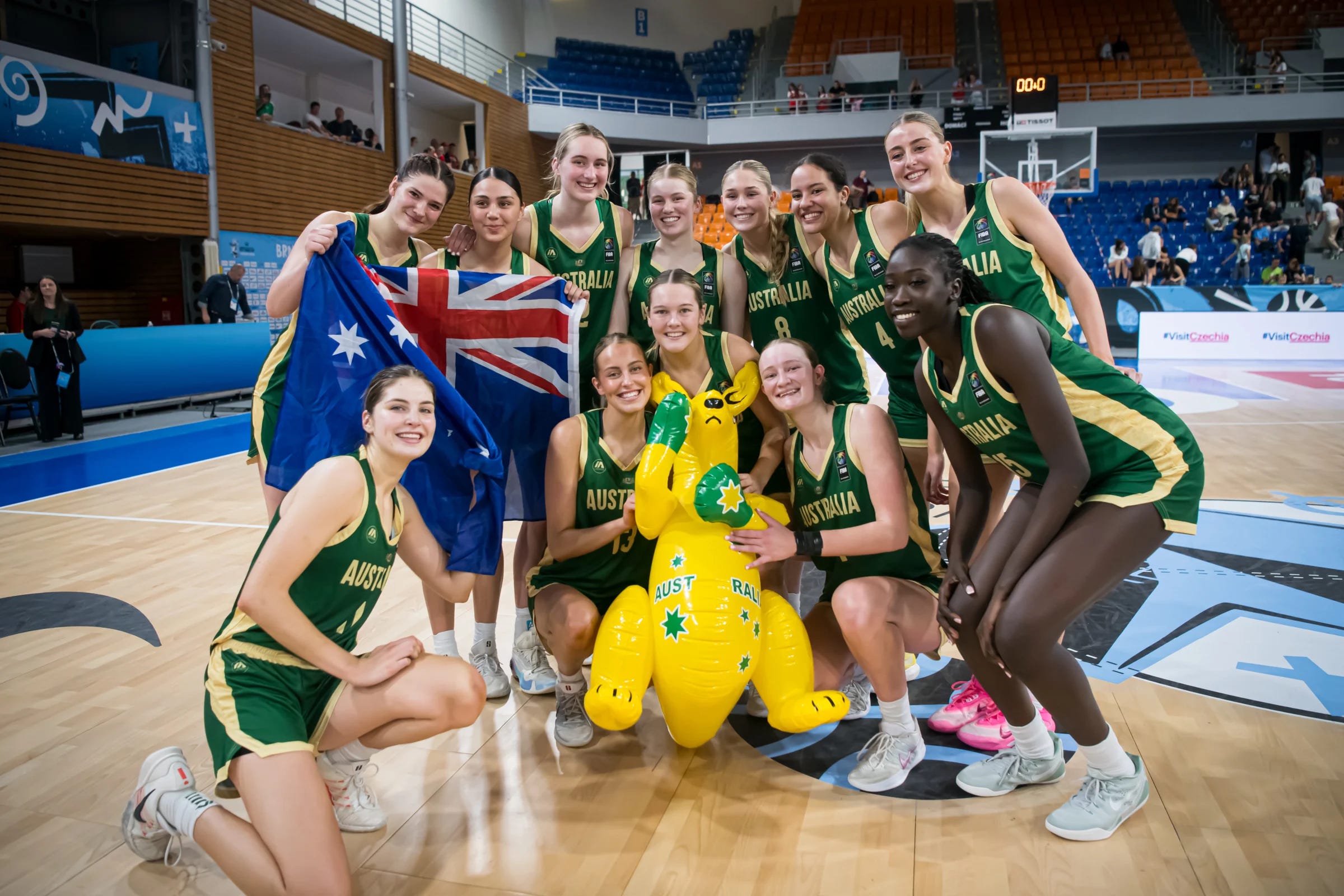
Image credit: FIBA
Australia’s Sapphires entered the U17 Women’s World Cup in Brno, Czechia as one of the heavyweights, and signalled their intent early in an impressive win over Latvia to kick off the group stage.
The team’s ability to apply full-court defensive pressure was pivotal in the contest. Remarkably, both Isabel Smith and Olivia Olechnowicz broke the team’s record for steals in this competition with seven each, eclipsing Abbey Wehrung’s six back in the 2012 tournament. Madi Ryan also gave an early display of her all-round ability, leading Australia in scoring (14, tied with Sophie Richardson for a team-high) and blocks (four).
The might of the USA, who had won the last three U17 World Cups, awaited Australia next. The USA team boasted names like Ivanna Wilson Manyacka (the tournament MVP), Eve Long and Caroline Bradley, who were all named in the top five of ESPNW’s Class of 2027 rankings, but Australia was undaunted by the challenge. Trailing by nine with a minute to play, a pair of threes to Sophie Richardson set up a nail-biting finish before Australia’s inbound pass on the buzzer went astray. Still, the result had underlined the resilience of the Sapphires as well as their talent and it ended up being the USA’s closest game of the event.
In the Sapphires’ remaining group game against Côte d’Ivoire, they simply had far too much talent for their opponents, and coach Tom Garlepp was able to give some different players court time, including bigs Lily Mapp (six points, seven rebounds and three blocks) and Jemyma Manyok (13 points, 11 rebounds and four blocks) and guard Jasmine Jones (15 points, five threes and four assists) in the 87-39 rout as Australia broke their record for most assists in a game at this tournament.
The Round of 16 clash against Germany was similarly one-sided and Australia had basically sealed it at quarter time, where they led 27-3. A late flurry from Germany against Australia’s bench group made the scoreline more respectable, but Australia’s starting five had been utterly dominant.
That result set up a quarter final against a Japan side headlined by dynamic point guard Miya Takeuchi (who had 32 points in the game). Australia never quite looked comfortable but managed to finish ahead 70-64. The Sapphires’ greater size was telling with a 44-26 rebound led by Matilda Trout’s 14 boards.
The dream of a gold medal clash with the USA was alive late into the semi-final with Spain, where despite some cold shooting from Australia (they only went 4 from 24 from three-point range), a Sophie Richardson three-pointer tied it up at 50-50 in the closing minutes. Another all-round display from Madi Ryan (12 points, nine rebounds, four assists and two blocks) got Australia, who never led and trailed by 13 late in the second quarter, back into the contest. But a relentless and balanced Spanish team dominated the final stretch to run away 59-51 winners.
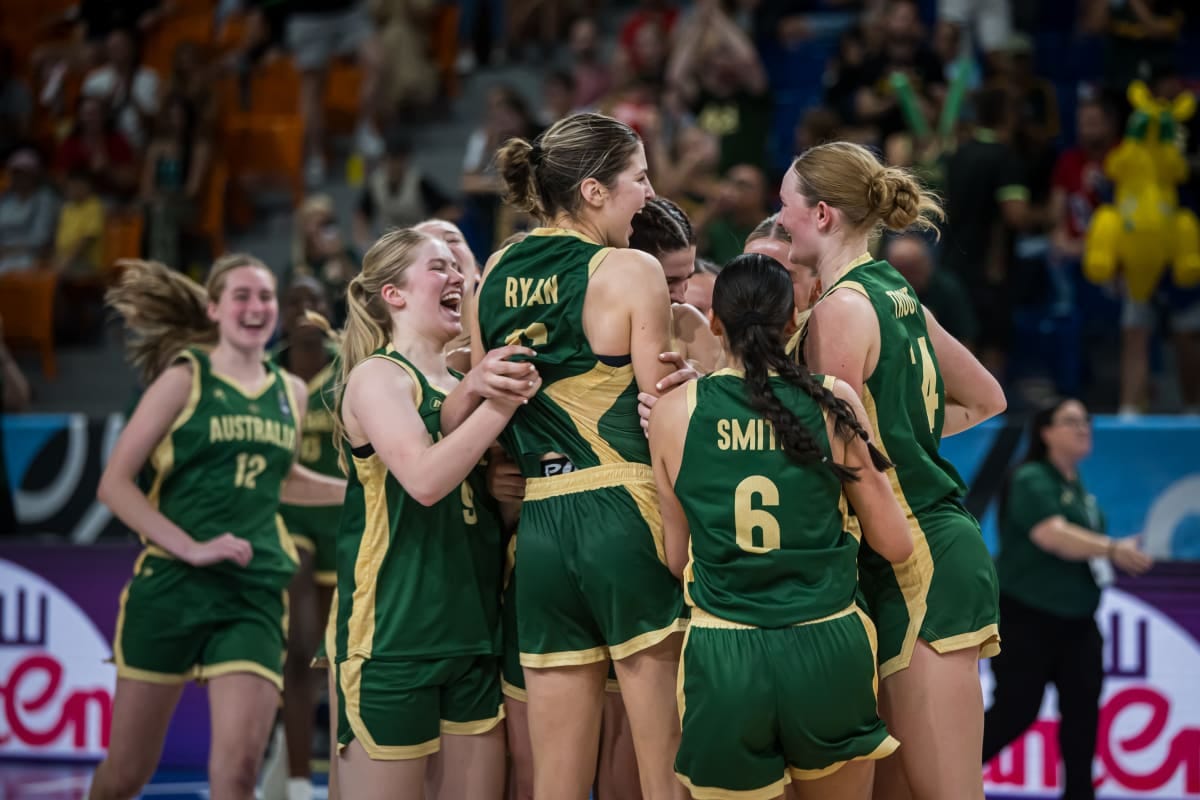
The loss to Spain left Australia to battle Canada for third place. It was another close contest, but this time the Sapphires were the more poised team down the stretch and they got some huge late stops to change the momentum of the game. Forward Jay Sebasio had her most impactful cameo of the tournament, troubling Canada with her cutting to record eight points in quick time. A three from Olivia Olechnowicz, who was huge on both ends, pushed Australia to the lead with just over a minute to go and Smith, Ryan and Olechnowicz were all perfect from the line as Australia ran away with a 64-57 win.
Madi Ryan has been a prolific winner at junior international level even while playing up an age group and was again Australia’s star of the tournament. At 191cm, the Sandringham Sabres star has the size for the frontcourt but handles the ball, makes plays and knocks down mid-range jumpers like a seasoned guard. Her basketball IQ is tremendous, and her versatility is rarely seen at this level. Seamlessly moving between different positions depending on what the team needed and holding up across big minutes (she played every minute of the semi-final against Spain), she ranked in the top 10 in scoring (14.1 points per game), field-goal percentage (47.2%), blocks (1.3 per game) and efficiency (a rating of 16.1 per game) and was selected in the tournament’s All-Star Five.
Olivia Olechnowicz also cemented her status as one of Australia’s brightest backcourt prospects across the tournament. A multi-level scorer who can post up, get downhill or shoot from outside (40% from three-point range), she ranked in the top 20 for scoring with 12.1 points per game. She was even more impactful on the defensive end, using her aggressive mindset and instincts to hound opposition players and rack up 3.3 steals per game, good for second in the tournament. Selection as the Best Defensive Player and in the All-Second Team were just reward for her non-stop hustle.
Isabel Smith was another huge contributor with 11.9 points per game. She consistently got to the line across the tournament (and made her free-throws at 80%, placing her in the top five of this category) and her ability to get a step on defenders was on full display against the USA’s bevy of long and athletic wings, where she had a tournament-high 20 points. Even when her shots weren’t falling, Smith found a way to contribute; against Latvia where she went two from 15 from the field, she contributed seven steals and two blocks.
In the frontcourt, Sophie Richardson (eight points per game) looks the modern prototype of a successful wing player; she is long and athletic and can get up and down the court, knock down outside shots and contribute on the glass. Matilda Trout gave the team a mobile big, and her 7.6 rebounds per game placed her in the top 10. She finished with a cumulative plus/minus of 68, behind only Ryan and Olechnowicz. Queenslander Jade Sherrington played hard and unselfish basketball in her court time and has great playmaking instincts at 184cm.
Finally, Jemyma Manyok only played limited minutes but continues to improve and is an intriguing long-term prospect. While she is still developing her offensive repertoire, her shot-blocking is already otherworldly, highlighted in a five-block effort in the bronze medal game. She was the tournament’s leading shot-blocker despite playing just over 14 minutes a game and recorded an outrageous 6.5 blocks per 40 minutes.
Credit: FIBA
It took a collective effort from the squad to win their first medal at this level since 2018 and highlights the depth and talent of this generation of Australian basketballers.
Sapphires squad: Eliza Ashby, Jasmine Jones, Jemyma Manyok, Lily Mapp, Olivia Olechnowicz, Sophie Richardson, Madi Ryan, Jay Sebasio, Jade Sherrington, Isabel Smith, Matilda Trout